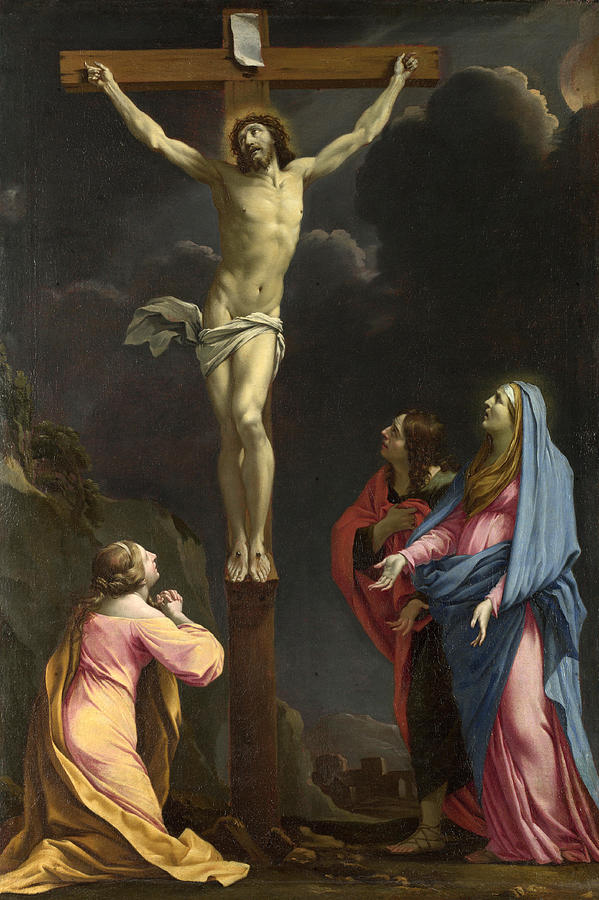
The third scene in Part II covers three events leading up to Jesus’ death on the cross.
First, the Evangelist narrates how the soldiers split up Jesus’ garments and cast lots for his tunic. This introduction leads to a choral intervention in which the choir impersonates the soldiers. It’s a lively, energetic fugal construct in triple meter, on a 4-bar-long subject which starts percussively with repeated eighths, gathers energy with a syncopation, travels over conjunct eighths and ends with a fast set of sixteenths and a wide leap downward – a masterful musical description of “casting lots”. The mood is playful and animated, in triple tempo, illustrating the soldiers’ self-absorption and obliviousness to the magnitude of what’s unfolding in front of them.
The next vignette is the touching, and theologically meaningful, moment in which Jesus entrusts his mother and “the disciple whom he loved” to one another. Scholars interpret this gesture as Jesus creating community at the cross, forming new relationships not based on family ties but on faith and discipleship. The chorale inserted right after Jesus’ words as a reflection is stanza 20 of Stockmann’s Passion hymn “Jesu Leiden, Pein und Tod”, which was used also (stanza 10) at the end of Part I.
In the last depiction of the scene, we hear the final words of Jesus and witness his death. The Evangelist tells us how Jesus says “I’m thirsty” to cause the fulfillment of the Scripture (Psalm 69). Jesus final utterance, “Es ist vollbracht!” (“It is finished!”) leads directly into the following aria, a musical interpretation of this climactic moment. Its text comes from Postel’s Passion libretto and presumably it was adopted by Bach’s librettist unmodified.
The aria starts in common time, on a tempo marking of “molt’ adagio”, with a very ornamental, lamento-like solo viola da gamba over a slow-moving continuo line. The opening ritornello is four bars long, after which the alto enters using some of the same melodic material and similar ornamental gestures. The upward leaps of a sixth on “O Trost” (“O comfort”) are particularly noteworthy as a typical expression of longing or anguish. Then, in a shocking change of affect, Bach musically summarizes St. John’s unique portrayal of Jesus’ crucifixion and death as ultimate victory and glorification: as the text says “The hero of Judah triumphs with might and ends the struggle”, Bach switches the tempo to Vivace, the meter to triple, and adds the string orchestra on festive ascending sixteenths and prolonged trills on high notes, depicting Jesus’ victorious kingship in bright, almost defiant D major. Notably, after this outburst of festive energy Bach returns to the opening material briefly to end with the voice saying “Es ist vollbracht” one final time.
After the aria, the Evangelist points out that Jesus bows his head and dies.
Another bass aria with interspersed choral interventions provides a combination of poetic commentary and communal representation through a hymn. The text for the solo voice comes from Brockes, with significant modifications. Bach’s librettist removed the allegorical characters that were present in Brockes’ text (Daughter of Zion and the believing soul). The dialog structure is preserved, but the text for both characters is consolidated and given to the bass, while the congregation is brought in as his interlocutor via a chorale: yet another stanza of Stockmann’s hymn, now its last one (number 34). The bass asks a series of rhetorical questions, while the choir answers implicitly and delivers assurance. Musically, the aria projects a feeling of comfort and tenderness via its meter (12/8), syncopated rhythmic pattern, and explicit trills in the ritornello material. It’s simply scored for bass solo and continuo, plus the homophonic interventions of the choir delivering the Stockmann text.