The Cantata Trail

A listening journey through Bach's vocal music

Part II/2: Condemnation and Crucifixion

St. John Passion, BWV 245.1

The second scene of Part II opens with Gospel narrative, including three interventions by the choir impersonating the vociferous crowd. After the Evangelist tells us that the soldiers put the crown of thorns and purple robe on Jesus, the first choral segment illustrates the mockery of the crowd by means of a simple fugal subject (an upward leap of a fourth followed by a descending scale in eighths) entering in quick succession on all the voices. Bach doubles the voices with the strings, but continues to use some instruments on independent, very active parts (in this case, flute/oboe 1 and flute/oboe 2) to create a mood of agitation and nervousness.

The Evangelist resumes the narration: Pilate takes Jesus in front of the crowd, which starts yelling “Crucify!”. Bach uses two different motifs for this word, the only one in the choir’s utterance. Over 24 bars, he overlaps a dactylic pattern – eighth and two sixteenths – repeated incessantly on “kreu-zi-ge” (which gives the music a strong forward propulsion) with another motif on half notes, syncopated over the barlines, causing the word to be stretched out. The winds double the voices, but the upper strings (violin 1, 2 and viola) have independent parts also made out of those two elements. The resulting effect is as if the instruments were also shouting.

Pilate tells the crowd to take Jesus and crucify him themselves. That prompts another response from the choir, this time on a more substantial piece of text. Bach now uses a fugue with a longer subject. The voices are introduced in order starting from the basses, moving upwards to the tenors, then altos and sopranos, and the orchestra doubles the voices. Possibly because the text refers to “the law”, the setting is closer to the older construct of the motet, with the instruments doubling the voices, resulting in strict four-part counterpoint.

Another exchange between Pilate and Jesus leads us to a break in the action, for a community reflection via a chorale (movement 22). Interestingly, the text for this chorale is not from a hymn. Rather, it’s by Christian Heinrich Postel as part of a St. John Passion libretto he wrote around 1693 in Hamburg. The stanza was designated as an aria in Postel’s work, but Bach transformed it into a chorale using a melody by Johann Hermann Schein dating back to 1628. The text, reflecting on Jesus’ imprisonment and bondage, appears at the same point in the narrative of Postel’s libretto as Bach’s transformed chorale setting.

After the chorale, another significant stretch of narrative follows, shaped as an episodic movement, and again we have three choral interventions. The first one is again a fugue, very similar to the one before with only subtle variations on the subject. This musical similarity highlights the fact that both texts are making a point based on tradition or law.

The rational and orderly affect of the fugue doesn’t last long, though. Pilate presents Jesus to the crowd and they start shouting again – “Away, away with him, crucify him!” Bach returns to the angular writing, using short note values, rests, and the same combination of dactylic short pattern and longer, syncopated note values for “kreuzige”. The winds again double the voices (oboe with sopranos, oboe d’amore with altos, and flutes in unison with tenors at the octave) while the strings have independent parts.

After Pilate’s question, “Shall I crucify your king?”, the choir declares “We have no king but Caesar” in a short reprise of the musical material used in the first two turba choruses (in Part I). Delivery is homophonic with independent instrumental part and a busy “moto perpetuo” line in sixteenth notes on the flutes in unison.

The Evangelist describes how Jesus is taken away to Golgotha, with an expressive raising and descending arpeggio on the word “gekreuziget” (“crucified”).

For the next poetic commentary, the librettist reworks another section of Brockes’ libretto. Like before, he replaces Brockes’ more obscure and almost grotesque images with more direct devotional language, sharpening the movement’s focus on Golgotha. In Bach’s version, the text becomes a dialog between the bass and the choir (soprano, alto and tenor) impersonating “the troubled souls”. The bass urges the souls to hurry to the “hill of the cross”, as the place where “salvation will blossom”. Bach sets the aria’s accompaniment to strings and continuo in a dynamic triple meter. The ritornello material, in unison, clearly conveys the spirit of “hurrying” – a quick ascending scale ending on an upward arpeggio, landing two octaves higher. The same motif is imitated by the continuo two bars later, and by the solo singer (minus the final arpeggio). The choir’s interjections (“Wohin?”) are homophonic on an upward leap. Bach through-composes the aria, bringing back the “A” section of the text on similar, but not identical, music.

The Evangelist then describes the crucifixion and mentions the inscription that Pilate placed on the cross. The words of the inscription (“Jesus of Nazareth, the King of the Jews”) are delivered as a metered “adagio” within the recitative. The choir, again representing the priests, tell Pilate to change the wording. The musical setting for this intervention is similar to that of 21b – connecting the references to the “King of the Jews” expression.

As Pilate states that “what he has written, he has written”, the librettist inserts a personal prayer in the form of a chorale. The text is stanza 3 of Valerius Herberger’s “Valet will ich dir geben”, of 1613. Jesus’ name, publicly written on the sign, and the cross itself, are brought inside the believer’s heart as a source of joy and comfort.
Condemnation and Crucifixion
21a. Rezitativ (T)

EVANGELIST
Und die Kriegsknechte flochten eine Krone von Dornen und satzten sie auf sein Haupt und legten ihm ein Purpurkleid an und sprachen:
21a. Recitative (Tenor)

EVANGELIST
And the soldiers twisted together a crown of thorns and placed it on his head and put a purple robe on him and said:
21b. Chor
Sei gegrüßet, lieber Jüdenkönig!
21b. Chorus
Hail, dear King of the Jews!
21c. Rezitativ (T, B)

EVANGELIST
Und gaben ihm Backenstreiche. Da ging Pilatus wieder heraus und sprach zu ihnen:

PILATUS
Sehet, ich führe ihn heraus zu euch, dass ihr erkennet, dass ich keine Schuld an ihm finde.

EVANGELIST
Also ging Jesus heraus und trug eine Dornenkrone und Purpurkleid. Und er sprach zu ihnen:

PILATUS
Sehet, welch ein Mensch!

EVANGELIST
Da ihn die Hohenpriester und die Diener sahen, schrieen sie und sprachen:
21c. Recitative (Tenor, Bass)

EVANGELIST
And they struck him on the cheek. Then Pilate went out again and said to them:

PILATE
See, I bring him out to you so that you may know that I find no guilt in him.

EVANGELIST
Then Jesus came out wearing the crown of thorns and the purple robe. And he said to them:

PILATE
Behold the man!

EVANGELIST
When the chief priests and the officers saw him, they cried out and said:
21d. Chor
Kreuzige, kreuzige!
21d. Chorus
Crucify, crucify!
21e. Rezitativ (T, B)

EVANGELIST
Pilatus sprach zu ihnen:

PILATUS
Nehmet ihr ihn hin und kreuziget ihn; denn ich finde keine Schuld an ihm!

EVANGELIST
Die Jüden antworteten ihm:
21e. Recitative (Tenor, Bass)

EVANGELIST
Pilate said to them:

PILATE
Take him yourselves and crucify him; for I find no guilt in him!

EVANGELIST
The Jews answered him:
21f. Chor
Wir haben ein Gesetz, und nach dem Gesetz soll er sterben; denn er hat sich selbst zu Gottes Sohn gemacht.
21f. Chorus
We have a law, and according to the law he ought to die, because he made himself the Son of God.
21g. Rezitativ (T, B I/II)

EVANGELIST
Da Pilatus das Wort hörete, fürchtet' er sich noch mehr und ging wieder hinein in das Richthaus und spricht zu Jesu:

PILATUS
Von wannen bist du?

EVANGELIST
Aber Jesus gab ihm keine Antwort. Da sprach Pilatus zu ihm:

PILATUS
Redest du nicht mit mir? Weißest du nicht, dass ich Macht habe, dich zu kreuzigen, und Macht habe, dich loszugeben?

EVANGELIST
Jesus antwortete:

JESUS
Du hättest keine Macht über mich, wenn sie dir nicht wäre von oben herab gegeben; darum, der mich dir überantwortet hat, der hat's größ're Sünde.

EVANGELIST
Von dem an trachtete Pilatus, wie er ihn losließe.
21g. Recitative (Tenor, Bass I/II)

EVANGELIST
When Pilate heard this statement, he became even more afraid and went again into the praetorium and said to Jesus:

PILATE
Where are you from?

EVANGELIST
But Jesus gave him no answer. Then Pilate said to him:

PILATE
Will you not speak to me? Do you not know that I have authority to crucify you and authority to release you?

EVANGELIST
Jesus answered:

JESUS
You would have no authority over me unless it had been given to you from above; therefore the one who handed me over to you has the greater sin.

EVANGELIST
From then on Pilate sought to release him.

John 19: 2-12a
22. Choral
Durch dein Gefängnis, Gottes Sohn,
Muss uns die Freiheit kommen;
Dein Kerker ist der Gnadenthron,
Die Freistatt aller Frommen;
Denn gingst du nicht die Knechtschaft ein,
Müsst unsre Knechtschaft ewig sein.
22. Chorale
Through your imprisonment, Son of God,
Freedom must come to us;
Your prison is the throne of grace,
The refuge of all the faithful;
For if you had not entered into bondage,
Our bondage would have been eternal.
23a. Rezitativ (T)

EVANGELIST
Die Jüden aber schrieen und sprachen:
23a. Recitative (Tenor)

EVANGELIST
But the Jews cried out and said:
23b. Chor
Lässest du diesen los, so bist du des Kaisers Freund nicht; denn wer sich zum Könige machet, der ist wider den Kaiser.
23b. Chorus
If you release this man, you are not Caesar’s friend; for whoever makes himself a king sets himself against Caesar.
23c. Rezitativ (T, B)

EVANGELIST
Da Pilatus das Wort hörete, führete er Jesum heraus und satzte sich auf den Richtstuhl, an der Stätte, die da heißet: Hochpflaster, auf Ebräisch aber: Gabbatha. Es war aber der Rüsttag in Ostern um die sechste Stunde, und er spricht zu den Jüden:

PILATUS
Sehet, das ist euer König!

EVANGELIST
Sie schrieen aber:
23c. Recitative (Tenor, Bass)

EVANGELIST
When Pilate heard these words, he brought Jesus out and sat down on the judgment seat at a place called the Stone Pavement, in Hebrew Gabbatha. It was the day of Preparation for the Passover, about the sixth hour, and he said to the Jews:

PILATE
Behold your king!

EVANGELIST
But they cried out:
23d. Chor
Weg, weg mit dem, kreuzige ihn!
23d. Chorus
Away, away with him, crucify him!
23e. Rezitativ (T, B)

EVANGELIST
Spricht Pilatus zu ihnen:

PILATUS
Soll ich euren König kreuzigen?

EVANGELIST
Die Hohenpriester antworteten:
23e. Recitative (Tenor, Bass)

EVANGELIST
Pilate said to them:

PILATE
Shall I crucify your king?

EVANGELIST
The chief priests answered:
23f. Chor
Wir haben keinen König denn den Kaiser.
23f. Chorus
We have no king but Caesar.
23g. Rezitativ (T)

EVANGELIST
Da überantwortete er ihn, dass er gekreuziget würde. Sie nahmen aber Jesum und führeten ihn hin. Und er trug sein Kreuz und ging hinaus zur Stätte, die da heißet Schädelstätt, welche heißet auf Ebräisch: Golgatha.
23g. Recitative (Tenor)

EVANGELIST
Then he handed him over to them to be crucified. They took Jesus and led him away. And he carried his cross and went out to the place called the Place of the Skull, which in Hebrew is called Golgotha.

John 19: 12b-17
24. Aria (B) und Chor

BASS
Eilt, ihr angefochtnen Seelen,
Geht aus euren Marterhöhlen,
Eilt –

CHOR
Wohin?

BASS
nach Golgatha!
Nehmet an des Glaubens Flügel,
Flieht –

CHOR
Wohin?

BASS
zum Kreuzeshügel,
Eure Wohlfahrt blüht allda!
24. Aria (Bass) and Chorus

BASS
Hurry, you troubled souls,
Come out of your caves of torment,
Hurry –

CHOIR
Where to?

BASS
to Golgotha!
Take up the wings of faith,
Flee –

CHOIR
Where to?

BASS
to the hill of the cross,
There your salvation will blossom!
25a. Rezitativ (T)

EVANGELIST
Allda kreuzigten sie ihn, und mit ihm zween andere zu beiden Seiten, Jesum aber mitten inne. Pilatus aber schrieb eine Überschrift und satzte sie auf das Kreuz, und war geschrieben: "Jesus von Nazareth, der Jüden König". Diese Überschrift lasen viel Jüden, denn die Stätte war nahe bei der Stadt, da Jesus gekreuziget ist. Und es war geschrieben auf ebräische, griechische und lateinische Sprache. Da sprachen die Hohenpriester der Jüden zu Pilato:
25a. Recitative (Tenor)

EVANGELIST
There they crucified him, and with him two others, one on each side, and Jesus in the middle. Pilate also wrote an inscription and placed it on the cross; it read: "Jesus of Nazareth, the King of the Jews." Many of the Jews read this inscription, for the place where Jesus was crucified was near the city. And it was written in Hebrew, Greek, and Latin. Then the chief priests of the Jews said to Pilate:
25b. Chor
Schreibe nicht: der Jüden König, sondern dass er gesaget habe: Ich bin der Jüden König.
25b. Chorus
Do not write: "The King of the Jews," but that he said: "I am the King of the Jews."
25c. Rezitativ (T, B)

EVANGELIST
Pilatus antwortet:

PILATUS
Was ich geschrieben habe, das habe ich geschrieben.
25c. Recitative (Tenor, Bass)

EVANGELIST
Pilate answered:

PILATE
What I have written, I have written.

John 19: 18-22
26. Choral
In meines Herzens Grunde
Dein Nam und Kreuz allein
Funkelt all Zeit und Stunde,
Drauf kann ich fröhlich sein.
Erschein mir in dem Bilde
Zu Trost in meiner Not,
Wie du, Herr Christ, so milde
Dich hast geblut' zu Tod!
26. Chorale
In the depths of my heart
Your name and cross alone
Shine at every time and hour,
In which I can rejoice.
Appear to me in this image
As comfort in my distress,
How you, Lord Christ, so gently
Have bled yourself to death.

James Gilchrist, Evangelist
Matthew Rose, Jesus
Ashley Riches, Pilatus
Elizabeth Watts, Philippa Hyde, sopranos
Sarah Connolly, alto
Andrew Kennedy, James Geer, tenors
Christopher Purves, Richard Latham, basses
Academy of Ancient Music
Choir of the AAM
Richard Egarr

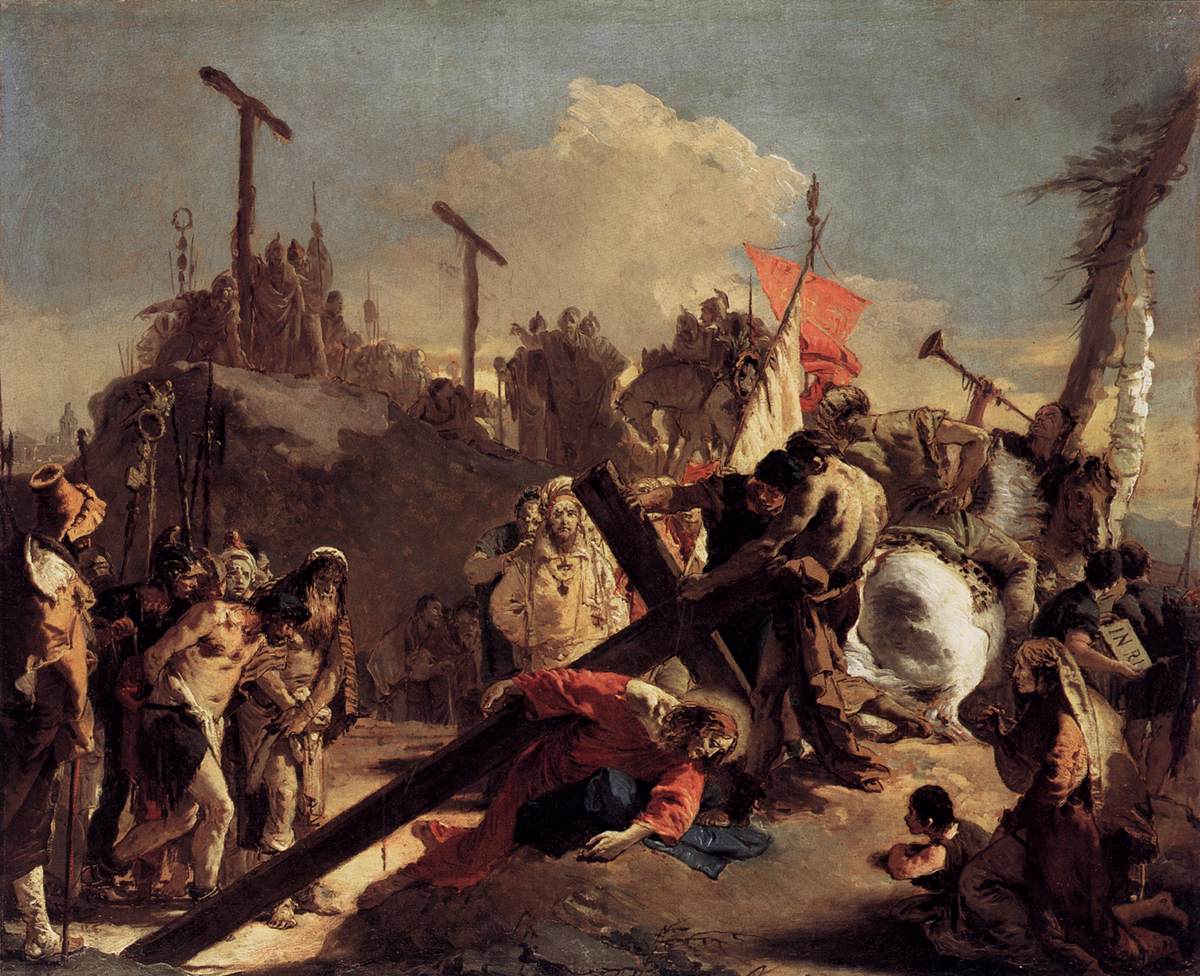
Christ Carrying the Cross

Giovanni Battista Tiepolo (ca. 1738)

Movements

21. Recitative (Tenor, Bass I/II) and Chorus
22. Chorale
23. Recitative (Tenor, Bass) and Chorus
24. Aria (Bass) und Chor
25. Recitative (Tenor, Bass) and Chorus
26. Chorale