The first scene of Part II opens with a chorale, whose text is the opening stanza of a Passion hymn by Michael Weiße (1531). The chorale functions as commentary that parallels and summarizes the Gospel account delivered in Part I. It serves as a connection point into the remainder of the narrative, after the long sermon that separates the two parts in the Vespers service.
Next is a long stretch of Gospel text. We hear the direct words of Pilate for the first time, assigned to a solo bass. The recitative is interrupted twice by high-energy, incisive interventions of the choir, still impersonating the group of servants and officers of the temple that apprehended Jesus. These interjections are relatively short, and Bach uses rhythmic and melodic patterns to highlight key words. First, “Übeltäter” (“criminal”) is set to mostly ascending chromatic sequences of quarter notes that shift among voices, and then “überantwortet” (“hand over”) uses repeated dactylic patterns of one eighth and two sixteenth notes, also in ascending sequences. The final “nicht” is striking, with several homophonic, short eighth-note chords separated by rests. The orchestra doubles the voices (violin 1 + oboe 1 with sopranos, violin 2 + oboe 2 with altos, viola with tenor, and continuo with basses), with the flutes on the tenor/viola line at the octave throughout. The second choral intervention highlights “töten” (“death”) via similar sequences of chromatic ascending quarter notes passed around the voices. The orchestral distribution changes: oboe 1 doubles the soprano on its own, while the flutes and violin 1 add to the frenetic energy via a jumpy string of non-stop sixteenth notes above everybody else. The movement closes with a final stretch of recitative, in which Bach underlines Jesus’ words “my servants would fight” via a short, ornamental arioso.
At this point, Bach and his librettist insert another community reflection through a chorale. The text is stanzas 8 and 9 from the same Heermann hymn we first encountered in movement 3, but in a different harmonization and higher key (A minor instead of G minor). The chorale introduces a pause in the trial narrative just after the first mention of Christ’s kingship (Pilate asking, “Are you the King of the Jews?” and Jesus responding a bit later, “My kingdom is not of this world”). The chorale opens with the words “Ah, great King”, and Bach hierarchizes this by raising the key signature of the chorale setting.
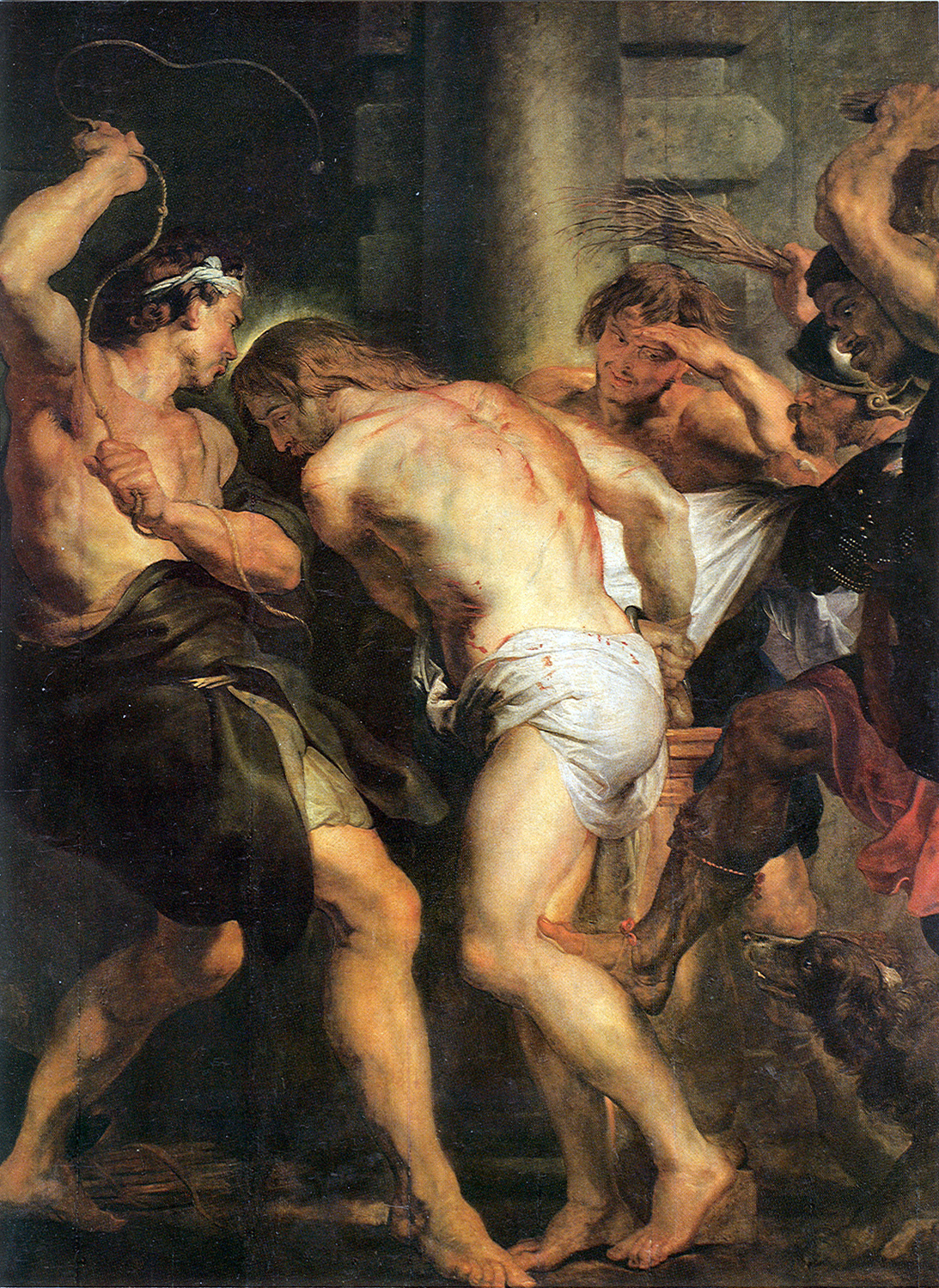
The narration of the trial resumes. Bach sets Jesus’ pronouncement “I am a king” to a declarative G major arpeggio over a sustained low G on the continuo line. Pilates offers to release Jesus, per the Passover custom, but the crowd outside the praetorium chooses Barabbas instead. Bach sets the words of the crowd, “Nicht diesen, sondern Barrabam!” as another short but energetic choral intervention. The voices sing homophonically, again with some instruments doubling them (oboe 2 with sopranos, violin 2 with altos, viola with tenors, continuo largely with basses) but now adding oboe 1 to the flutes and violin 1 on an independent arpeggiated line of perpetual-motion sixteenths. The movement closes with a dramatic stretch of arioso for the Evangelist as he mentions the scourging of Jesus, with a chain of dactylic cells and triplets over three bars of dotted rhythms on the bass line.
After this intense portrayal, it’s time once more to pause the narrative and provide commentary and opportunity for reflection. The librettist inserts an arioso/aria set, for the bass and tenor respectively. Both texts are taken from Brockes, but adapted freely rather than reproduced verbatim. The revisions consistently streamline Brockes’ more florid diction and soften some of his extravagant imagery.
In the arioso, which reflects on Jesus’ suffering, the alterations are relatively modest, with small adjustments in wording and emphasis, and an original line inserted at the end (“Drum sieh…”). The musical setting is an unhurried and deliberate delivery of the text in short phrases separated by rests, with slow continuo support in quarters on every other beat, and a delicate accompaniment by two violas d’amore and lute.
By contrast, the text of the aria was reworked more librerally, with its original syntax significantly reshaped. The imagery is concentrated into the single metaphor of the rainbow, representing Jesus’ flagellation marks on his back. The tenor is accompanied by the violas and a quite active continuo line. The structure is da-capo, and some interesting word-painting occurs on the main exhortation (“Erwäge”, “Consider”), set often to a long, sustained note. The image of the raising and lowering floodwaters is present throughout the entire movement on all parts via the main motif – one sixteenth and two thirty-seconds ascending and descending, chained together in different ways to result in longer ascending and descending phrases.