The Cantata Trail

A listening journey through Bach's vocal music

Part I/2: Peter’s Denial

St. John Passion, BWV 245.1

After a very brief utterance by the Evangelist (just half of verse 15), another aria follows. The Gospel mentions following Jesus, and this is the idea developed in the aria text. The scoring is for soprano, two flutes in unison, and continuo, in an agile and light triple tempo. The instrumental line is comprised of one-bar groups of sixteenth notes, either scalic or laid out in ascending sequences, evoking the idea of animated and enthusiastic “following”. In part B, there is a notable instance of word painting on “schieben” (“push”), via a chromatically ascending sequence. Textually the aria is da-capo, but Bach writes it out in full using a shortened ritornello and other variances as the opening material returns. The two flutes in unison create a unique sound color, providing at once a hint of a single-minded “collective” (maybe the two disciples mentioned in the introductory Gospel verse, with a single purpose?) and, on a practical level, ensuring better projection of the soft and sweet sound of the baroque traverse flute in the huge spaces of Nikolaikirche.

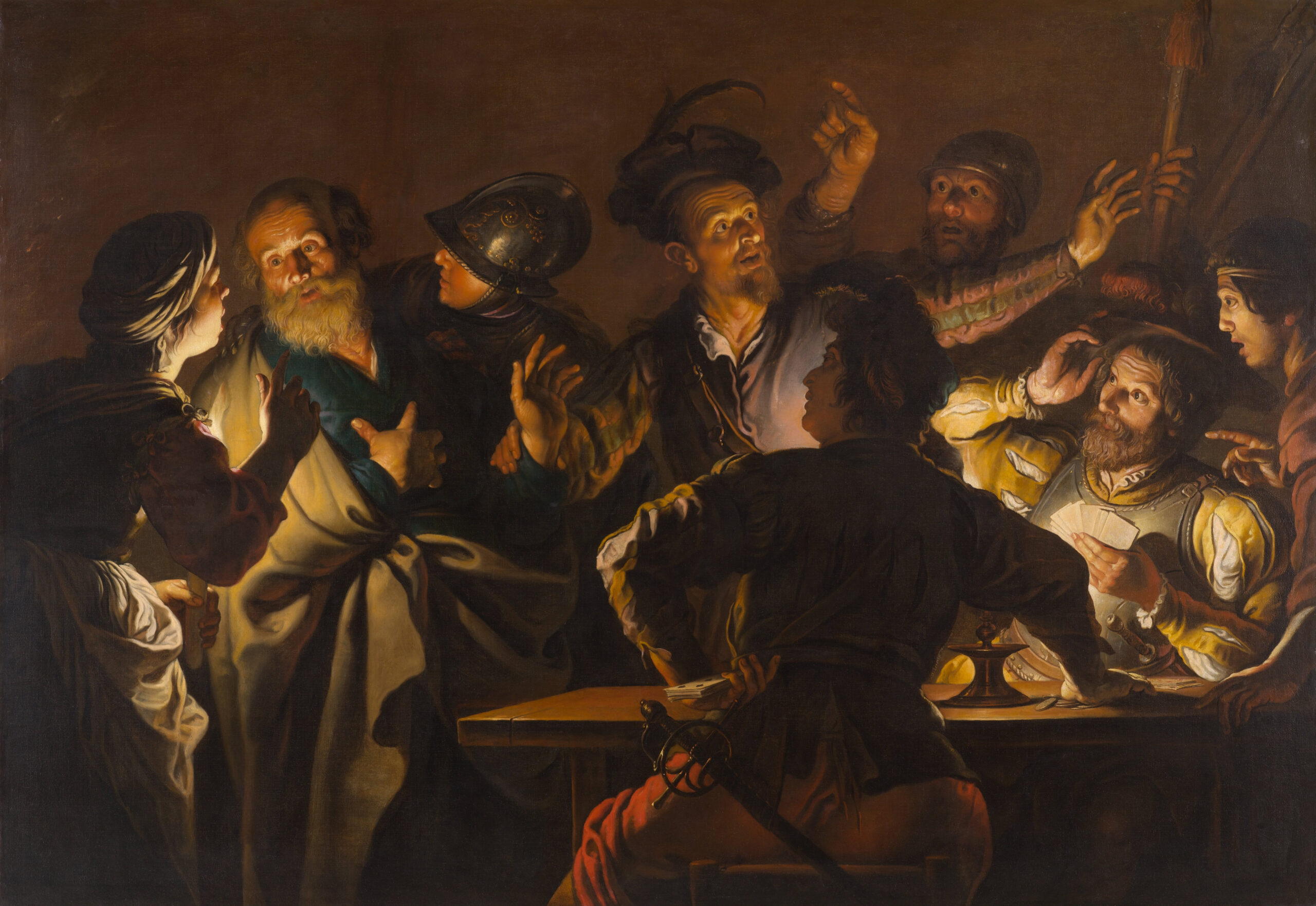
Movement 10 is a long stretch of Gospel narration, containing Peter’s first denial as the maid questions him, and Jesus’ interaction with Annas and his officer. Bach introduces a quick melodic turn to illustrate the servants and officers “warming themselves”. Jesus’ final question, “why do you strike me?”, prompts the following chorale as a reflection point: stanzas 3 and 4 of Paul Gerhardt’s “O Welt, sieh hier dein Leben”, of 1647, selected undoubtedly for their references to “striking”. Bach sets them in plain four-part harmony.

The Gospel narration continues, covering Peter’s second and third denial, this time upon being challenged first by the servants and officers with whom he was standing by the fire, then by a servant of the high priest. The choir impersonates the group of servants and officers, questioning Peter in a high-energy choral setting marked “allegro”, characterized by scattered anapestic (short-short-long) motifs with “staccato” markings on the long (quarter) notes. Peter’s response is exactly in the same figuration as the first one, but one step higher, portraying a rise in tension. The third denial is narrated by the Evangelist in a highly emotional setting. “Abermal” (“again”) is emphasized via three high G’s, and the crowing of the rooster is illustrated by an ascending arpeggio on the continuo line. At this point, the recitative inserts a verse from Matthew’s Gospel (26:75), describing Peter’s sudden remorse. His weeping is set to the first “arioso” of the Passion – a long melisma on “weinete” (“wept”) with syncopations on chromatic movements and wide leaps on the voice, on top of an implacable up and down chromatic scale on the basso continuo.

Unsurprisingly, Bach and his librettist take the opportunity to provide musical commentary on this highly charged, emotional moment. They insert an aria, on text borrowed and slightly adapted from Christian Weise’s poem “Der weinende Petrus” (“The weeping Peter”), part of “Der grünen Jugend nothwendigen Gedancken” (“Necessary reflections for inexperienced youth”), a pedagogical and rhetorical handbook first published in 1675 with several later reprints. Bach sets it as a tenor aria, accompanied by the strings and continuo. The music is angled, convoluted and full of tension, portraying Peter’s agitation and self-torturous remorse. With its dotted rhythms and harmonic instability, it approaches the operatic model of a “rage aria”, including the highly virtuosic and energetic vocal line, but the anger (or desperation!) is self-directed instead of pointed at another character.

The contrast can’t be more pronounced as we arrive at the next movement, the closing chorale for Part I. Using four-part homophonic harmony, Bach sets text that mentions Peter and articulates a prayer to Jesus asking him to “stir our conscience when having done evil”. It is stanza 10 from the hymn “Jesu Leiden, Pein und Tod”, by Paul Stockmann (1633), of which other stanzas will be heard in Part II.
Peter’s Denial
8. Rezitativ (T)

EVANGELIST
Simon Petrus aber folgete Jesu nach und ein ander Jünger.
8. Recitative (Tenor)

EVANGELIST
But Simon Peter followed Jesus, and another disciple.

John 18: 15a
9. Aria (S)
Ich folge dir gleichfalls mit freudigen Schritten
Und lasse dich nicht,
Mein Leben, mein Licht.
Befördre den Lauf
Und höre nicht auf,
Selbst an mir zu ziehen, zu schieben, zu bitten.
9. Aria (Soprano)
I likewise follow you with joyful steps
And will not leave you,
My life, my light.
Encourage my course
And never cease
To draw, to push, and to urge me onward.
10. Rezitativ (S, T I/II, B I/II)

EVANGELIST
Derselbige Jünger war dem Hohenpriester bekannt und ging mit Jesu hinein in des Hohenpriesters Palast. Petrus aber stund draußen für der Tür. Da ging der andere Jünger, der dem Hohenpriester bekannt war, hinaus und redete mit der Türhüterin und führete Petrum hinein. Da sprach die Magd, die Türhüterin, zu Petro:

MAGD
Bist du nicht dieses Menschen Jünger einer?

EVANGELIST
Er sprach:

PETRUS
Ich bin's nicht.

EVANGELIST
Es stunden aber die Knechte und Diener und hatten ein Kohlfeu'r gemacht (denn es war kalt) und wärmeten sich. Petrus aber stund bei ihnen und wärmete sich. Aber der Hohepriester fragte Jesum um seine Jünger und um seine Lehre. Jesus antwortete ihm:

JESUS
Ich habe frei, öffentlich geredet für der Welt. Ich habe allezeit gelehret in der Schule und in dem Tempel, da alle Juden zusammenkommen, und habe nichts im Verborgnen geredt. Was fragest du mich darum? Frage die darum, die gehöret haben, was ich zu ihnen geredet habe! Siehe, dieselbigen wissen, was ich gesaget habe.

EVANGELIST
Als er aber solches redete, gab der Diener einer, die dabeistunden, Jesu einen Backenstreich und sprach:

DIENER
Solltest du dem Hohenpriester also antworten?

EVANGELIST
Jesus aber antwortete:

JESUS
Hab ich übel geredt, so beweise es, dass es böse sei, hab ich aber recht geredt, was schlägest du mich?
10. Recitative (Soprano, Tenor I/II, Bass I/II)

EVANGELIST
That disciple was known to the high priest and went with Jesus into the high priest’s palace. But Peter stood outside at the door. Then the other disciple, who was known to the high priest, went out and spoke with the maid who kept the door and brought Peter in. Then the maid, the doorkeeper, said to Peter:

MAID
Are you not one of this man’s disciples?

EVANGELIST
He said:

PETER
I am not.

EVANGELIST
Now the servants and officers had made a charcoal fire (because it was cold) and were warming themselves. Peter also stood with them and warmed himself. But the high priest questioned Jesus about his disciples and about his teaching. Jesus answered him:

JESUS
I have spoken openly before the world. I have always taught in the synagogue and in the temple, where all the Jews gather, and I have said nothing in secret. Why do you question me about this? Question those who heard what I said to them. See, they know what I said.

EVANGELIST
But when he had said this, one of the officers standing by struck Jesus on the cheek and said:

OFFICER
Is that how you answer the high priest?

EVANGELIST
Jesus answered:

JESUS
If I have spoken wrongly, prove what was wrong; but if I have spoken rightly, why do you strike me?

John 18: 15b-23
11. Choral
Wer hat dich so geschlagen,
Mein Heil, und dich mit Plagen
So übel zugericht'?
Du bist ja nicht ein Sünder
Wie wir und unsre Kinder,
Von Missetaten weißt du nicht.

Ich, ich und meine Sünden,
Die sich wie Körnlein finden
Des Sandes an dem Meer,
Die haben dir erreget
Das Elend, das dich schläget,
Und das betrübte Marterheer.
11. Chorale
Who has struck you so,
My salvation, and with blows
So cruelly mistreated you?
You are surely not a sinner
Like we and our children;
You know nothing of transgression.

I, I and my sins,
Which are as countless
As grains of sand by the sea,
Have brought upon you
The misery that strikes you,
And the sorrowful host of torment.
12a. Rezitativ (T)

EVANGELIST
Und Hannas sandte ihn gebunden zu dem Hohenpriester Kaiphas. Simon Petrus stund und wärmete sich, da sprachen sie zu ihm:
12a. Recitative (Tenor)

EVANGELIST
And Annas sent him bound to Caiaphas the high priest. Simon Peter stood there warming himself. Then they said to him:
12b. Chor
Bist du nicht seiner Jünger einer?
12b. Chorus
Are you not one of his disciples?
12c. Rezitativ (T I, T II)

EVANGELIST
Er leugnete aber und sprach:

PETRUS
Ich bin's nicht.

EVANGELIST
Spricht des Hohenpriesters Knecht' einer, ein Gefreundter des, dem Petrus das Ohr abgehauen hatte:

KNECHT
Sahe ich dich nicht im Garten bei ihm?

EVANGELIST
Da verleugnete Petrus abermal, und alsobald krähete der Hahn.

Da gedachte Petrus an die Worte Jesu und ging hinaus und weinete bitterlich.
12c. Recitative (Tenor I, Tenor II)

EVANGELIST
But he denied it and said:

PETER
I am not.

EVANGELIST
One of the high priest’s servants, a relative of the man whose ear Peter had cut off, said:

SERVANT
Did I not see you with him in the garden?

EVANGELIST
Then Peter denied it again, and immediately the cock crowed.

John 18: 24-27
Then Peter remembered the words of Jesus and went out and wept bitterly.

Matthew 26: 75
13. Aria (T)
Ach, mein Sinn,
Wo willt du endlich hin,
Wo soll ich mich erquicken?
Bleib ich hier,
Oder wünsch ich mir
Berg und Hügel auf den Rücken?
Bei der Welt ist gar kein Rat,
Und im Herzen
Stehn die Schmerzen
Meiner Missetat,
Weil der Knecht den Herrn verleugnet hat.
13. Aria (Tenor)
Ah, my mind,
Where will you finally go,
Where shall I find relief?
Shall I remain here,
Or wish that
Mountains and hills might fall upon my back?
In the world there is no counsel,
And in my heart
Stand the sorrows
Of my transgression,
Because the servant has denied the Lord.
14. Choral
Petrus, der nicht denkt zurück,
Seinen Gott verneinet,
Der doch auf ein' ernsten Blick
Bitterlichen weinet.
Jesu, blicke mich auch an,
Wenn ich nicht will büßen;
Wenn ich Böses hab getan,
Rühre mein Gewissen!
14. Chorale
Peter, who does not reflect,
Denies his God,
Yet at a single earnest glance
Weeps bitterly.
Jesus, look upon me also
When I do not wish to repent;
When I have done evil,
Stir my conscience!

Werner Güra (tenor), Evangelist
Drew Santini (bass), Jesus
Alex Potter (alto)
Sophie Gallagher, Aleksandra Lewandowska (sopranos)
Maximilian Vogler, Olivier Coiffet (tenors)
Stephan Macleod (bass)
Gli Angeli Genève
Stephan Macleod

The Denial of St. Peter

Gerard Seghers (ca. 1623)

Movements

8. Recitative (Evangelist)
9. Aria (Soprano)
10. Recitative
(Evangelist, Maid, Petrus, Jesus, Servant)
11. Chorale
12. Recitative (Evangelist) and Chorus
13. Aria (Tenor)
14. Chorale