The Cantata Trail

A listening journey through Bach's vocal music

Part I/1: Betrayal and Arrest

St. John Passion, BWV 245.1

Most versions of the St. John Passion (except the 1725 one) open with a majestic and monumental choral fantasia that conveys musically one key idea from the Gospel of John: Jesus is glorified through his crucifixion. The tension between these two opposing concepts is easily heard in the music. A relentless, pulsating bass on a pedal tone, a “perpetual motion” weave on the upper strings, and piercing, dissonant syncopations on the oboes (doubled by flutes in later revisions) create a restless, anxious sonority that anticipates the tragedy of the Passion. The entrance of the choir, on a verse based on Psalm 8:1, starts with three homophonic proclamations of “Herr” (“Lord”) highlighting Jesus’ kingship right from the start. Then, “unser Herrscher” (“our Lord”), set to parallel patterns of ascending sixteenths, continues to reinforce this concept. The “B” section, crafted in the form of a traditional invitation (“invitatorium”) to reflect on the Passion, includes interesting word painting on the expression “deepest humiliation” (“größten Niedrigkeit”) via low, descending motifs in the voices, also marked “piano”. Interestingly, Bach brings back the musical material from section A early (i.e. before the “da capo”), in order to apply it to “Verherrlicht” (“glorified”), reinforcing the opening “Herr” proclamations.

Movement 2 is episodic, with sections that flow into each other. First, the Evangelist begins the narrative with John chapter 18. Then Jesus has his first intervention. Bach gives Jesus’ text (“vox Christi”, “the voice of Christ”) to the bass, as usual, but interestingly he doesn’t add strings to accompany Jesus’ speech (creating a sort of “musical halo”) like he almost always did in his cantatas and in the St. Matthew Passion. The choir also makes its first appearance, impersonating the group of soldiers and servants of the priests and Pharisees that accompany Judas to capture Jesus. The highly energetic, almost frantic, musical material that accompanies the choir becomes a characteristic of these choral interventions depicting crowds (“turbae”).

After this first confrontation, the Biblical narrative pauses and we arrive at our first collective reflection. The choir switches persona and now sings a plain four-part chorale setting on behalf of the congregation. The text is stanza 7 of “Herzliebster Jesus, was hast du verbrochen” by Johann Heermann, of 1630.

The Evangelist continues with the story, and we witness Jesus telling Simon Peter to put his sword away after he cuts off Malchus’ ear. Jesus’ words prompt another chorale, a prayer for patience and restrain in times of suffering. The text is stanza 4 of Martin Luther’s “Vater unser in Himmelreich” (1539). This hymn is Luther’s paraphrase of “The Lord’s Prayer”.

Another Gospel segment follows, describing Jesus being bound and taken before Annas. This leads to the first aria in the Passion. Its text is a paraphrase of the first movement of the “Brockes Passion” libretto (“Der für die Sünde der Welt gemarterte und sterbende Jesus”), an extremely famous text published in 1712 that had been set to music by many well-known composers such as Keiser, Telemann, Händel, Mattheson, and others. The aria, written in the first person so the listener identifies with the singer, uses the image of Jesus’ bonds described in the Gospel as a metaphor for one’s sin. The B section includes a mention of the “sores of vice”, a very baroque, graphical image that connects with the wounds to be inflicted on Jesus.

Musically, Bach sets it for the alto, accompanied by two oboes and continuo. Its triple tempo and gentle, dance-like character opens a parenthesis on the abrupt and physical Gospel narrative. The intertwining oboe lines, sometimes imitative, sometimes parallel, can be thought of as illustrating “Stricken” (“bonds”). However, the overall affect is one of release, not captivity. The aria is da-capo, but through-composed: Bach restates the opening material with variants.
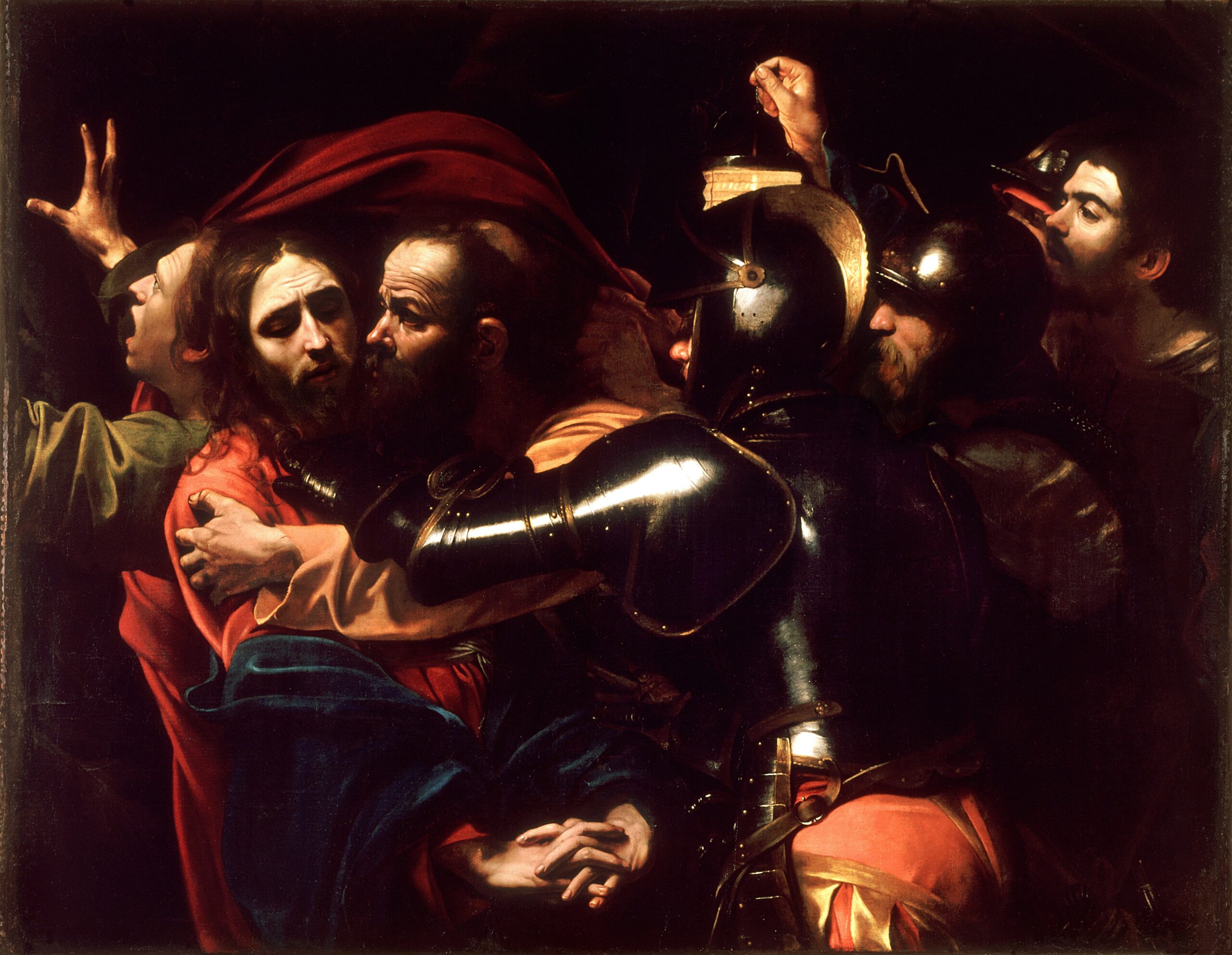
Betrayal and Arrest
1. Chor
Herr, unser Herrscher, dessen Ruhm
In allen Landen herrlich ist!
Zeig uns durch deine Passion,
Dass du, der wahre Gottessohn,
Zu aller Zeit,
Auch in der größten Niedrigkeit,
Verherrlicht worden bist!
1. Chorus
Lord, our ruler, whose praise
Is glorious in every land!
Show us through your Passion
That you, the true Son of God,
At all times,
Even in the deepest humiliation,
Have been glorified!
2a. Rezitativ (T, B)

EVANGELIST
Jesus ging mit seinen Jüngern über den Bach Kidron, da war ein Garten, darein ging Jesus und seine Jünger. Judas aber, der ihn verriet, wusste den Ort auch, denn Jesus versammlete sich oft daselbst mit seinen Jüngern. Da nun Judas zu sich hatte genommen die Schar und der Hohenpriester und Pharisäer Diener, kommt er dahin mit Fackeln, Lampen und mit Waffen. Als nun Jesus wusste alles, was ihm begegnen sollte, ging er hinaus und sprach zu ihnen:

JESUS
Wen suchet ihr?

EVANGELIST
Sie antworteten ihm:
2a. Recitative (Tenor, Bass)

EVANGELIST
Jesus went with his disciples across the brook Kidron, where there was a garden, into which Jesus and his disciples entered. But Judas, who betrayed him, also knew the place, because Jesus often gathered there with his disciples. Now when Judas had taken with him the band of soldiers and servants of the chief priests and Pharisees, he came there with torches, lanterns, and weapons. Then Jesus, knowing all that was to happen to him, went out and said to them:

JESUS
Whom do you seek?

EVANGELIST
They answered him:
2b. Chor
Jesum von Nazareth.
2b. Chorus
Jesus of Nazareth.
2c. Rezitativ (T, B)

EVANGELIST
Jesus spricht zu ihnen:

JESUS
Ich bin's.

EVANGELIST
Judas aber, der ihn verriet, stund auch bei ihnen. Als nun Jesus zu ihnen sprach: Ich bin's, wichen sie zurücke und fielen zu Boden. Da fragete er sie abermal:

JESUS
Wen suchet ihr?

EVANGELIST
Sie aber sprachen:
2c. Recitative (Tenor, Bass)

EVANGELIST
Jesus says to them:

JESUS
I am he.

EVANGELIST
But Judas, who betrayed him, was also standing with them. When Jesus said to them, “I am he,” they drew back and fell to the ground. Then he asked them again:

JESUS
Whom do you seek?

EVANGELIST
But they said:
2d. Chor
Jesum von Nazareth.
2d. Chorus
Jesus of Nazareth.
2e. Rezitativ (T, B)

EVANGELIST
Jesus antwortete:

JESUS
Ich hab's euch gesagt, dass ich's sei, suchet ihr denn mich, so lasset diese gehen!
2e. Recitative (Tenor, Bass)

EVANGELIST
Jesus answered:

JESUS
I have told you that I am he; if then you seek me, let these go their way!

John 18: 1-8
3. Choral
O große Lieb, o Lieb ohn' alle Maße,
Die dich gebracht auf diese Marterstraße!
Ich lebte mit der Welt in Lust und Freuden,
Und du mußt leiden.
3. Chorale
O great love, O love beyond all measure,
That brought you onto this path of suffering!
I lived with the world in pleasure and joys,
And you must suffer.
4. Rezitativ (T, B)

EVANGELIST
Auf dass das Wort erfüllet würde, welches er sagte: Ich habe der keine verloren, die du mir gegeben hast. Da hatte Simon Petrus ein Schwert und zog es aus und schlug nach des Hohenpriesters Knecht und hieb ihm sein recht Ohr ab; und der Knecht hieß Malchus. Da sprach Jesus zu Petro:

JESUS
Stecke dein Schwert in die Scheide! Soll ich den Kelch nicht trinken, den mir mein Vater gegeben hat?
4. Recitative (Tenor, Bass)

EVANGELIST
So that the word might be fulfilled which he had spoken: I have lost none of those whom you have given me. Then Simon Peter had a sword and drew it and struck the high priest’s servant and cut off his right ear; and the servant’s name was Malchus. Then Jesus said to Peter:

JESUS
Put your sword into its sheath! Shall I not drink the cup that my Father has given me?

John 18: 9-11
5. Choral
Dein Will gescheh, Herr Gott, zugleich
Auf Erden wie im Himmelreich.
Gib uns Geduld in Leidenszeit,
Gehorsam sein in Lieb und Leid;
Wehr und steur allem Fleisch und Blut,
Das wider deinen Willen tut!
5. Chorale
May your will be done, Lord God, alike
On earth as in the kingdom of heaven.
Grant us patience in time of suffering,
To be obedient in love and sorrow;
Restrain and curb all flesh and blood
That acts against your will!
6. Rezitativ (T)

EVANGELIST
Die Schar aber und der Oberhauptmann und die Diener der Jüden nahmen Jesum und bunden ihn und führeten ihn aufs erste zu Hannas, der war Kaiphas Schwäher, welcher des Jahres Hoherpriester war. Es war aber Kaiphas, der den Juden riet, es wäre gut, dass ein Mensch würde umbracht für das Volk.
6. Recitative (Tenor)

EVANGELIST
Then the band of soldiers and the captain and the servants of the Jews took Jesus and bound him and led him first to Annas, who was Caiaphas’s father-in-law, who was high priest that year. But Caiaphas was the one who had advised the Jews that it was good for one man to be put to death for the people.

John 18: 12-14
7. Aria (A)
Von den Stricken meiner Sünden
Mich zu entbinden,
Wird mein Heil gebunden.
Mich von allen Lasterbeulen
Völlig zu heilen,
Lässt er sich verwunden.
7. Aria (Alto)
To release me
From the bonds of my sins,
My salvation is bound.
To heal me completely
Of all the sores of vice,
He lets himself be wounded.

Werner Güra (tenor), Evangelist
Drew Santini (bass), Jesus
Alex Potter (alto)
Sophie Gallagher, Aleksandra Lewandowska (sopranos)
Maximilian Vogler, Olivier Coiffet (tenors)
Stephan Macleod (bass)
Gli Angeli Genève
Stephan Macleod

The Taking of Christ

Michelangelo Merisi da Caravaggio (1602)

Movements

1. Chorus: Exordium
2. Recitative (Evangelist, Jesus) and Chorus
3. Chorale
4. Recitative (Evangelist, Jesus)
5. Chorale
6. Recitative (Evangelist)
7. Aria (Alto)