The Cantata Trail

A listening journey through Bach's vocal music

Part II/3: The Death of Jesus

St. John Passion, BWV 245.1

The third scene in Part II covers three events leading up to Jesus’ death on the cross.

First, the Evangelist narrates how the soldiers split up Jesus’ garments and cast lots for his tunic. This introduction leads to a choral intervention in which the choir impersonates the soldiers. It’s a lively, energetic fugal construct in triple meter, on a 4-bar-long subject which starts percussively with repeated eighths, gathers energy with a syncopation, travels over conjunct eighths and ends with a fast set of sixteenths and a wide leap downward – a masterful musical description of “casting lots”. The mood is playful and animated, in triple tempo, illustrating the soldiers’ self-absorption and obliviousness to the magnitude of what’s unfolding in front of them.

The next vignette is the touching, and theologically meaningful, moment in which Jesus entrusts his mother and “the disciple whom he loved” to one another. Scholars interpret this gesture as Jesus creating community at the cross, forming new relationships not based on family ties but on faith and discipleship. The chorale inserted right after Jesus’ words as a reflection is stanza 20 of Stockmann’s Passion hymn “Jesu Leiden, Pein und Tod”, which was used also (stanza 10) at the end of Part I.

In the last depiction of the scene, we hear the final words of Jesus and witness his death. The Evangelist tells us how Jesus says “I’m thirsty” to cause the fulfillment of the Scripture (Psalm 69). Jesus final utterance, “Es ist vollbracht!” (“It is finished!”) leads directly into the following aria, a musical interpretation of this climactic moment. Its text comes from Postel’s Passion libretto and presumably it was adopted by Bach’s librettist unmodified.

The aria starts in common time, on a tempo marking of “molt’ adagio”, with a very ornamental, lamento-like solo viola da gamba over a slow-moving continuo line. The opening ritornello is four bars long, after which the alto enters using some of the same melodic material and similar ornamental gestures. The upward leaps of a sixth on “O Trost” (“O comfort”) are particularly noteworthy as a typical expression of longing or anguish. Then, in a shocking change of affect, Bach musically summarizes St. John’s unique portrayal of Jesus’ crucifixion and death as ultimate victory and glorification: as the text says “The hero of Judah triumphs with might and ends the struggle”, Bach switches the tempo to Vivace, the meter to triple, and adds the string orchestra on festive ascending sixteenths and prolonged trills on high notes, depicting Jesus’ victorious kingship in bright, almost defiant D major. Notably, after this outburst of festive energy Bach returns to the opening material briefly to end with the voice saying “Es ist vollbracht” one final time.

After the aria, the Evangelist points out that Jesus bows his head and dies.

Another bass aria with interspersed choral interventions provides a combination of poetic commentary and communal representation through a hymn. The text for the solo voice comes from Brockes, with significant modifications. Bach’s librettist removed the allegorical characters that were present in Brockes’ text (Daughter of Zion and the believing soul). The dialog structure is preserved, but the text for both characters is consolidated and given to the bass, while the congregation is brought in as his interlocutor via a chorale: yet another stanza of Stockmann’s hymn, now its last one (number 34). The bass asks a series of rhetorical questions, while the choir answers implicitly and delivers assurance. Musically, the aria projects a feeling of comfort and tenderness via its meter (12/8), syncopated rhythmic pattern, and explicit trills in the ritornello material. It’s simply scored for bass solo and continuo, plus the homophonic interventions of the choir delivering the Stockmann text.
The Death of Jesus
27a. Rezitativ (T)

EVANGELIST
Die Kriegsknechte aber, da sie Jesum gekreuziget hatten, nahmen seine Kleider und machten vier Teile, einem jeglichen Kriegesknechte sein Teil, dazu auch den Rock. Der Rock aber war ungenähet, von oben an gewürket durch und durch. Da sprachen sie untereinander:
27a. Recitative (Tenor)

EVANGELIST
Then the soldiers, when they had crucified Jesus, took his garments and made four parts, one part for each soldier, and also the tunic. But the tunic was seamless, woven from the top throughout. Then they said among themselves:
27b. Chor
Lasset uns den nicht zerteilen, sondern darum losen, wes er sein soll.
27b. Chorus
Let us not divide it, but cast lots for it to see whose it shall be.
27c. Rezitativ (T, B)

EVANGELIST
Auf dass erfüllet würde die Schrift, die da saget: Sie haben meine Kleider unter sich geteilet und haben über meinen Rock das Los geworfen, Solches taten die Kriegesknechte. Es stund aber bei dem Kreuze Jesu seine Mutter und seiner Mutter Schwester, Maria, Kleophas Weib, und Maria Magdalena. Da nun Jesus seine Mutter sahe und den Jünger dabei stehen, den er lieb hatte, spricht er zu seiner Mutter:

JESUS
Weib, siehe, das ist dein Sohn!

EVANGELIST
Darnach spricht er zu dem Jünger:

JESUS
Siehe, das ist deine Mutter!
27c. Recitative (Tenor, Bass)

EVANGELIST
So that the Scripture might be fulfilled which says: They divided my garments among them and cast lots for my tunic. This the soldiers did. Now standing by the cross of Jesus were his mother and his mother’s sister, Mary the wife of Clopas, and Mary Magdalene. When Jesus saw his mother and the disciple whom he loved standing there, he said to his mother:

JESUS
Woman, behold your son!

EVANGELIST
Then he said to the disciple:

JESUS
Behold your mother!

John 19: 23-27a
28. Choral
Er nahm alles wohl in acht
In der letzten Stunde,
Seine Mutter noch bedacht,
Setzt ihr ein' Vormunde.
O Mensch, mache Richtigkeit,
Gott und Menschen liebe,
Stirb darauf ohn alles Leid,
Und dich nicht betrübe!
28. Chorale
He took care of everything well
In his final hour,
Still mindful of his mother,
He appointed her a guardian.
O man, set your affairs in order,
Love God and your fellow men,
Then die without any sorrow,
And do not be troubled!
29. Rezitativ (T, B)

EVANGELIST
Und von Stund an nahm sie der Jünger zu sich. Darnach, als Jesus wusste, dass schon alles vollbracht war, dass die Schrift erfüllet würde, spricht er:

JESUS
Mich dürstet!

EVANGELIST
Da stund ein Gefäße voll Essigs. Sie fülleten aber einen Schwamm mit Essig und legten ihn um einen Isopen, und hielten es ihm dar zum Munde. Da nun Jesus den Essig genommen hatte, sprach er:

JESUS
Es ist vollbracht!
29. Recitative (Tenor, Bass)

EVANGELIST
And from that hour the disciple took her into his own home. After this, when Jesus knew that all was now accomplished, so that the Scripture might be fulfilled, he said:

JESUS
I thirst!

EVANGELIST
There stood a vessel full of vinegar. They filled a sponge with vinegar and put it on a hyssop branch and held it up to his mouth. When Jesus had received the vinegar, he said:

JESUS
It is finished!

John 19: 27b-30a
30. Aria (A)
Es ist vollbracht!
O Trost vor die gekränkten Seelen!
Die Trauernacht
Lässt nun die letzte Stunde zählen.
Der Held aus Juda siegt mit Macht
Und schließt den Kampf.
Es ist vollbracht!
30. Aria (Alto)
It is finished!
O comfort for afflicted souls!
The night of sorrow
Now counts the final hour.
The hero from Judah triumphs with might
And ends the struggle.
It is finished!
31. Rezitativ (T)

EVANGELIST
Und neiget das Haupt und verschied.
31. Recitative (Tenor)

EVANGELIST
And he bowed his head and gave up his spirit.

John 19: 30b
32. Aria (B) und Choral

BASS
Mein teurer Heiland, lass dich fragen,

CHOR
Jesu, der du warest tot,

BASS
Da du nunmehr ans Kreuz geschlagen
Und selbst gesagt: Es ist vollbracht,

CHOR
Lebest nun ohn Ende,

BASS
Bin ich vom Sterben frei gemacht?

CHOR
In der letzten Todesnot
Nirgend mich hinwende

BASS
Kann ich durch deine Pein und Sterben
Das Himmelreich ererben?
Ist aller Welt Erlösung da?

CHOR
Als zu dir, der mich versühnt,
O du lieber Herre!

BASS
Du kannst vor Schmerzen zwar nichts sagen;

CHOR
Gib mir nur, was du verdient,

BASS
Doch neigest du das Haupt
Und sprichst stillschweigend: ja.

CHOR
Mehr ich nicht begehre!
32. Aria (Bass) and Chorale

BASS
My dear Savior, let me ask you,

CHOIR
Jesus, you who were dead,

BASS
Now that you are nailed to the cross
And yourself have said: It is finished,

CHOIR
Now you live forever,

BASS
Am I freed from dying?

CHOIR
In the final agony of death
I turn nowhere

BASS
Can I through your suffering and death
Inherit the kingdom of heaven?
Is the redemption of all the world accomplished?

CHOIR
Except to you, who have reconciled me,
O dear Lord!

BASS
You indeed can say nothing because of pain;

CHOIR
Give me only what you have earned,

BASS
Yet you bow your head
And silently say: yes.

CHOIR
I desire nothing more!

Maria Keohane, Helena Ek, sopranos
Carlos Mena, Jan Börner, altos
Hans-Jörg Mammel (Evangelist), Jan Kobow, tenors
Matthias Vieweg (Jesus), Stephan MacLeod, basses
Ricercar Consort
Philippe Pierlot

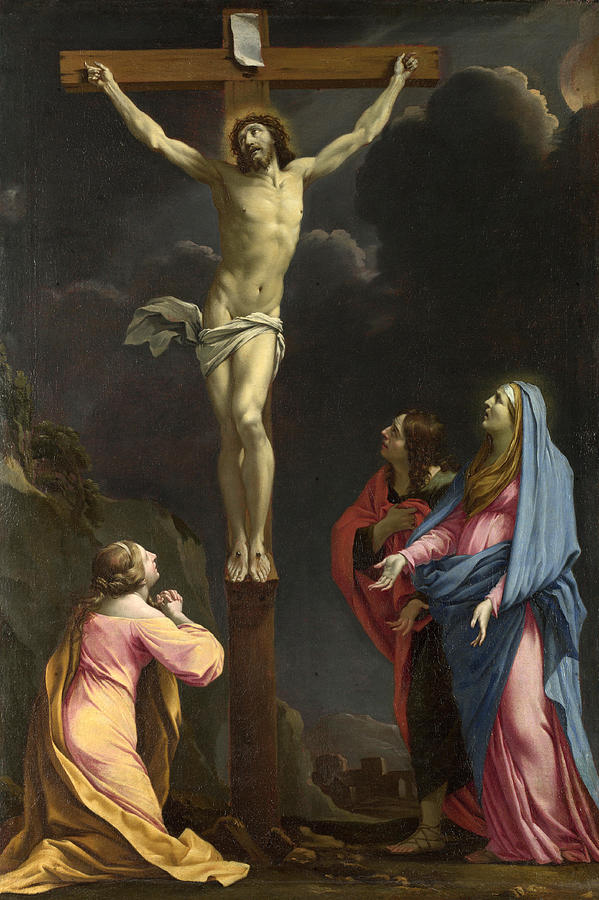
Christ on the Cross with the Magdalen, the Virgin Mary and Saint John the Evangelist

Eustache Le Sueur (ca. 1643)

Movements

27. Recitative (Tenor) and Chorus
28. Chorale
29. Recitative (Tenor, Bass)
30. Aria (Alto)
31. Recitative (Tenor)
32. Aria (Bass) and Chorale