The second scene of Part II opens with Gospel narrative, including three interventions by the choir impersonating the vociferous crowd. After the Evangelist tells us that the soldiers put the crown of thorns and purple robe on Jesus, the first choral segment illustrates the mockery of the crowd by means of a simple fugal subject (an upward leap of a fourth followed by a descending scale in eighths) entering in quick succession on all the voices. Bach doubles the voices with the strings, but continues to use some instruments on independent, very active parts (in this case, flute/oboe 1 and flute/oboe 2) to create a mood of agitation and nervousness.
The Evangelist resumes the narration: Pilate takes Jesus in front of the crowd, which starts yelling “Crucify!”. Bach uses two different motifs for this word, the only one in the choir’s utterance. Over 24 bars, he overlaps a dactylic pattern – eighth and two sixteenths – repeated incessantly on “kreu-zi-ge” (which gives the music a strong forward propulsion) with another motif on half notes, syncopated over the barlines, causing the word to be stretched out. The winds double the voices, but the upper strings (violin 1, 2 and viola) have independent parts also made out of those two elements. The resulting effect is as if the instruments were also shouting.
Pilate tells the crowd to take Jesus and crucify him themselves. That prompts another response from the choir, this time on a more substantial piece of text. Bach now uses a fugue with a longer subject. The voices are introduced in order starting from the basses, moving upwards to the tenors, then altos and sopranos, and the orchestra doubles the voices. Possibly because the text refers to “the law”, the setting is closer to the older construct of the motet, with the instruments doubling the voices, resulting in strict four-part counterpoint.
Another exchange between Pilate and Jesus leads us to a break in the action, for a community reflection via a chorale (movement 22). Interestingly, the text for this chorale is not from a hymn. Rather, it’s by Christian Heinrich Postel as part of a St. John Passion libretto he wrote around 1693 in Hamburg. The stanza was designated as an aria in Postel’s work, but Bach transformed it into a chorale using a melody by Johann Hermann Schein dating back to 1628. The text, reflecting on Jesus’ imprisonment and bondage, appears at the same point in the narrative of Postel’s libretto as Bach’s transformed chorale setting.
After the chorale, another significant stretch of narrative follows, shaped as an episodic movement, and again we have three choral interventions. The first one is again a fugue, very similar to the one before with only subtle variations on the subject. This musical similarity highlights the fact that both texts are making a point based on tradition or law.
The rational and orderly affect of the fugue doesn’t last long, though. Pilate presents Jesus to the crowd and they start shouting again – “Away, away with him, crucify him!” Bach returns to the angular writing, using short note values, rests, and the same combination of dactylic short pattern and longer, syncopated note values for “kreuzige”. The winds again double the voices (oboe with sopranos, oboe d’amore with altos, and flutes in unison with tenors at the octave) while the strings have independent parts.
After Pilate’s question, “Shall I crucify your king?”, the choir declares “We have no king but Caesar” in a short reprise of the musical material used in the first two turba choruses (in Part I). Delivery is homophonic with independent instrumental part and a busy “moto perpetuo” line in sixteenth notes on the flutes in unison.
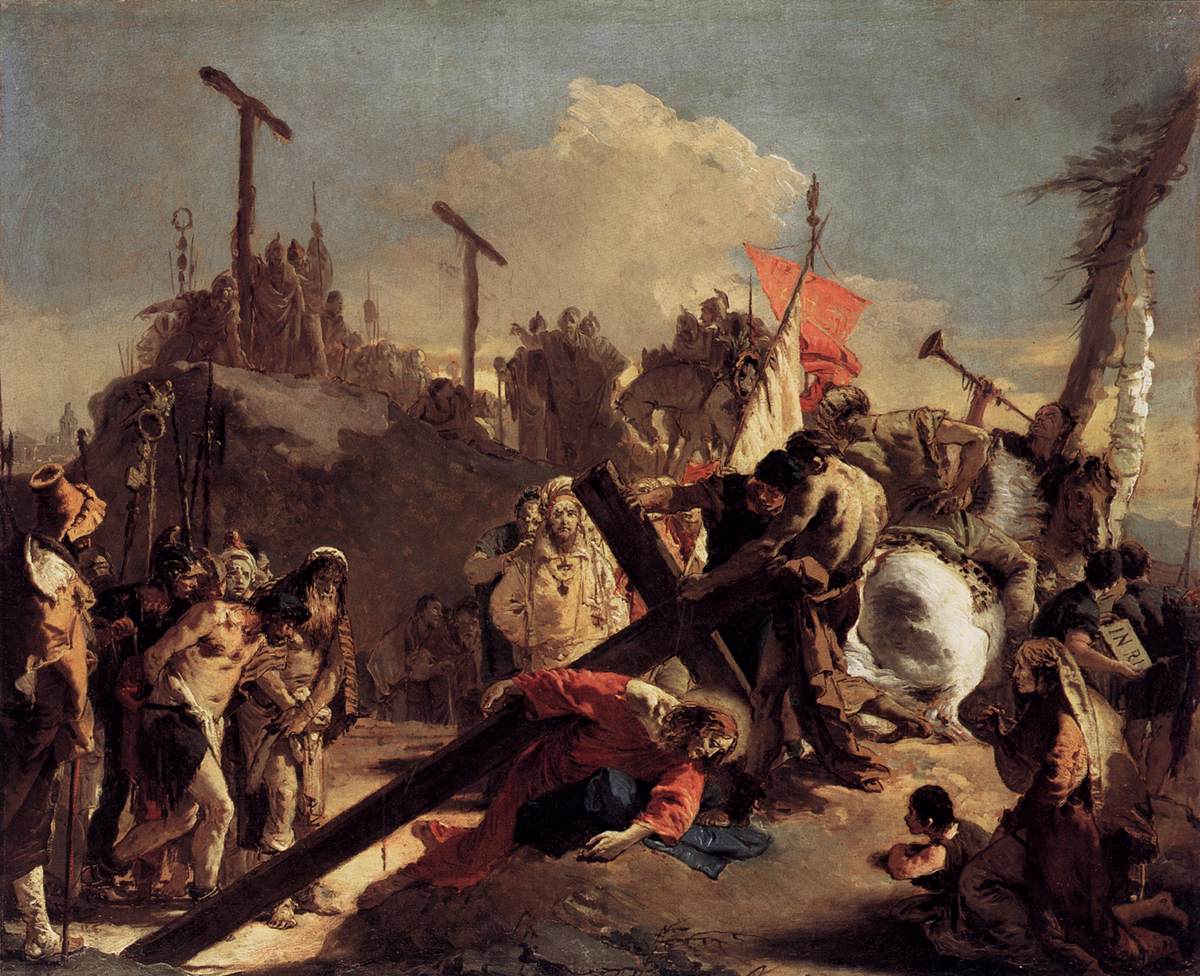
The Evangelist describes how Jesus is taken away to Golgotha, with an expressive raising and descending arpeggio on the word “gekreuziget” (“crucified”).
For the next poetic commentary, the librettist reworks another section of Brockes’ libretto. Like before, he replaces Brockes’ more obscure and almost grotesque images with more direct devotional language, sharpening the movement’s focus on Golgotha. In Bach’s version, the text becomes a dialog between the bass and the choir (soprano, alto and tenor) impersonating “the troubled souls”. The bass urges the souls to hurry to the “hill of the cross”, as the place where “salvation will blossom”. Bach sets the aria’s accompaniment to strings and continuo in a dynamic triple meter. The ritornello material, in unison, clearly conveys the spirit of “hurrying” – a quick ascending scale ending on an upward arpeggio, landing two octaves higher. The same motif is imitated by the continuo two bars later, and by the solo singer (minus the final arpeggio). The choir’s interjections (“Wohin?”) are homophonic on an upward leap. Bach through-composes the aria, bringing back the “A” section of the text on similar, but not identical, music.
The Evangelist then describes the crucifixion and mentions the inscription that Pilate placed on the cross. The words of the inscription (“Jesus of Nazareth, the King of the Jews”) are delivered as a metered “adagio” within the recitative. The choir, again representing the priests, tell Pilate to change the wording. The musical setting for this intervention is similar to that of 21b – connecting the references to the “King of the Jews” expression.
As Pilate states that “what he has written, he has written”, the librettist inserts a personal prayer in the form of a chorale. The text is stanza 3 of Valerius Herberger’s “Valet will ich dir geben”, of 1613. Jesus’ name, publicly written on the sign, and the cross itself, are brought inside the believer’s heart as a source of joy and comfort.