After a very brief utterance by the Evangelist (just half of verse 15), another aria follows. The Gospel mentions following Jesus, and this is the idea developed in the aria text. The scoring is for soprano, two flutes in unison, and continuo, in an agile and light triple tempo. The instrumental line is comprised of one-bar groups of sixteenth notes, either scalic or laid out in ascending sequences, evoking the idea of animated and enthusiastic “following”. In part B, there is a notable instance of word painting on “schieben” (“push”), via a chromatically ascending sequence. Textually the aria is da-capo, but Bach writes it out in full using a shortened ritornello and other variances as the opening material returns. The two flutes in unison create a unique sound color, providing at once a hint of a single-minded “collective” (maybe the two disciples mentioned in the introductory Gospel verse, with a single purpose?) and, on a practical level, ensuring better projection of the soft and sweet sound of the baroque traverse flute in the huge spaces of Nikolaikirche.
Movement 10 is a long stretch of Gospel narration, containing Peter’s first denial as the maid questions him, and Jesus’ interaction with Annas and his officer. Bach introduces a quick melodic turn to illustrate the servants and officers “warming themselves”. Jesus’ final question, “why do you strike me?”, prompts the following chorale as a reflection point: stanzas 3 and 4 of Paul Gerhardt’s “O Welt, sieh hier dein Leben”, of 1647, selected undoubtedly for their references to “striking”. Bach sets them in plain four-part harmony.
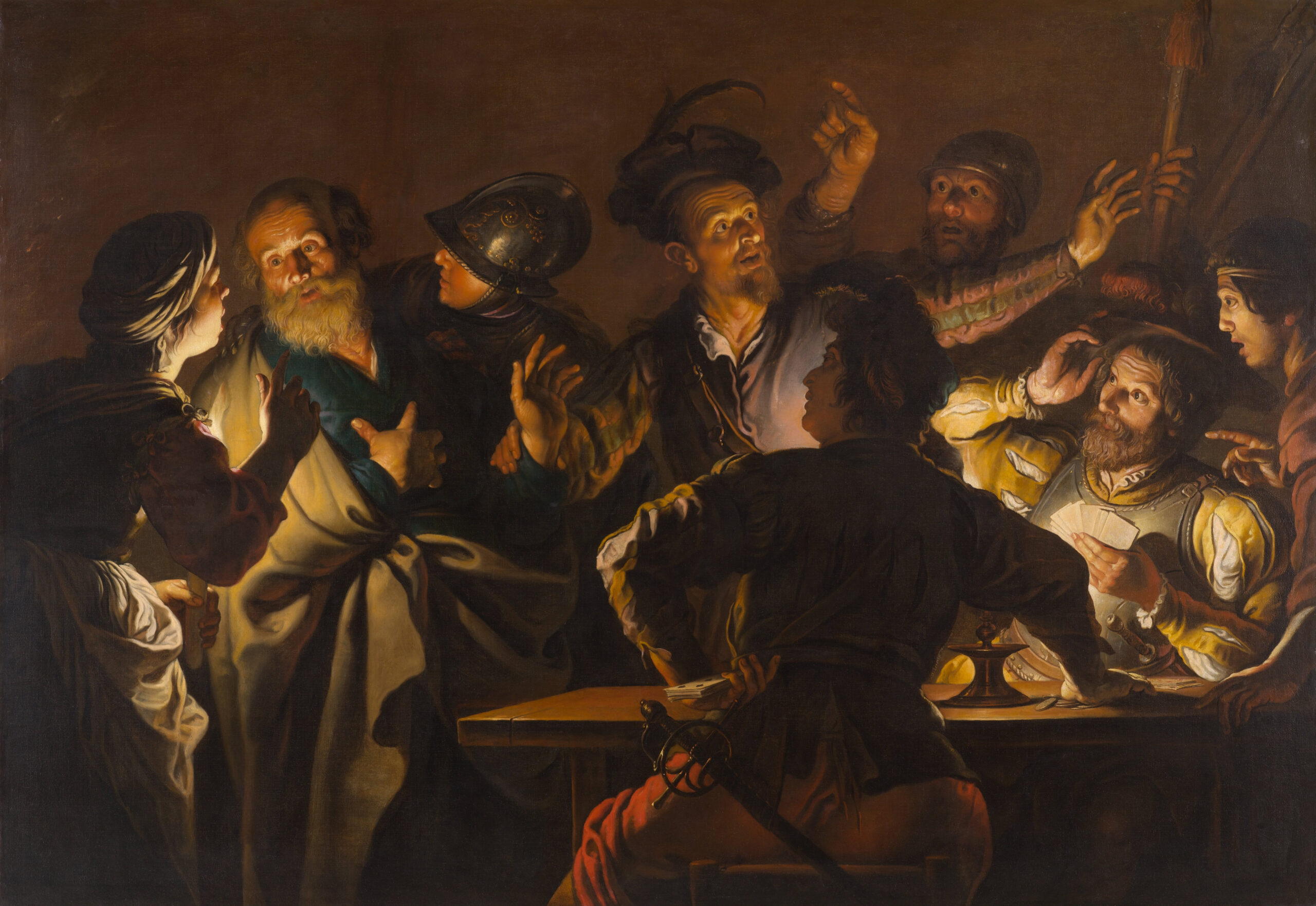
The Gospel narration continues, covering Peter’s second and third denial, this time upon being challenged first by the servants and officers with whom he was standing by the fire, then by a servant of the high priest. The choir impersonates the group of servants and officers, questioning Peter in a high-energy choral setting marked “allegro”, characterized by scattered anapestic (short-short-long) motifs with “staccato” markings on the long (quarter) notes. Peter’s response is exactly in the same figuration as the first one, but one step higher, portraying a rise in tension. The third denial is narrated by the Evangelist in a highly emotional setting. “Abermal” (“again”) is emphasized via three high G’s, and the crowing of the rooster is illustrated by an ascending arpeggio on the continuo line. At this point, the recitative inserts a verse from Matthew’s Gospel (26:75), describing Peter’s sudden remorse. His weeping is set to the first “arioso” of the Passion – a long melisma on “weinete” (“wept”) with syncopations on chromatic movements and wide leaps on the voice, on top of an implacable up and down chromatic scale on the basso continuo.
Unsurprisingly, Bach and his librettist take the opportunity to provide musical commentary on this highly charged, emotional moment. They insert an aria, on text borrowed and slightly adapted from Christian Weise’s poem “Der weinende Petrus” (“The weeping Peter”), part of “Der grünen Jugend nothwendigen Gedancken” (“Necessary reflections for inexperienced youth”), a pedagogical and rhetorical handbook first published in 1675 with several later reprints. Bach sets it as a tenor aria, accompanied by the strings and continuo. The music is angled, convoluted and full of tension, portraying Peter’s agitation and self-torturous remorse. With its dotted rhythms and harmonic instability, it approaches the operatic model of a “rage aria”, including the highly virtuosic and energetic vocal line, but the anger (or desperation!) is self-directed instead of pointed at another character.
The contrast can’t be more pronounced as we arrive at the next movement, the closing chorale for Part I. Using four-part homophonic harmony, Bach sets text that mentions Peter and articulates a prayer to Jesus asking him to “stir our conscience when having done evil”. It is stanza 10 from the hymn “Jesu Leiden, Pein und Tod”, by Paul Stockmann (1633), of which other stanzas will be heard in Part II.