Most versions of the St. John Passion (except the 1725 one) open with a majestic and monumental choral fantasia that conveys musically one key idea from the Gospel of John: Jesus is glorified through his crucifixion. The tension between these two opposing concepts is easily heard in the music. A relentless, pulsating bass on a pedal tone, a “perpetual motion” weave on the upper strings, and piercing, dissonant syncopations on the oboes (doubled by flutes in later revisions) create a restless, anxious sonority that anticipates the tragedy of the Passion. The entrance of the choir, on a verse based on Psalm 8:1, starts with three homophonic proclamations of “Herr” (“Lord”) highlighting Jesus’ kingship right from the start. Then, “unser Herrscher” (“our Lord”), set to parallel patterns of ascending sixteenths, continues to reinforce this concept. The “B” section, crafted in the form of a traditional invitation (“invitatorium”) to reflect on the Passion, includes interesting word painting on the expression “deepest humiliation” (“größten Niedrigkeit”) via low, descending motifs in the voices, also marked “piano”. Interestingly, Bach brings back the musical material from section A early (i.e. before the “da capo”), in order to apply it to “Verherrlicht” (“glorified”), reinforcing the opening “Herr” proclamations.
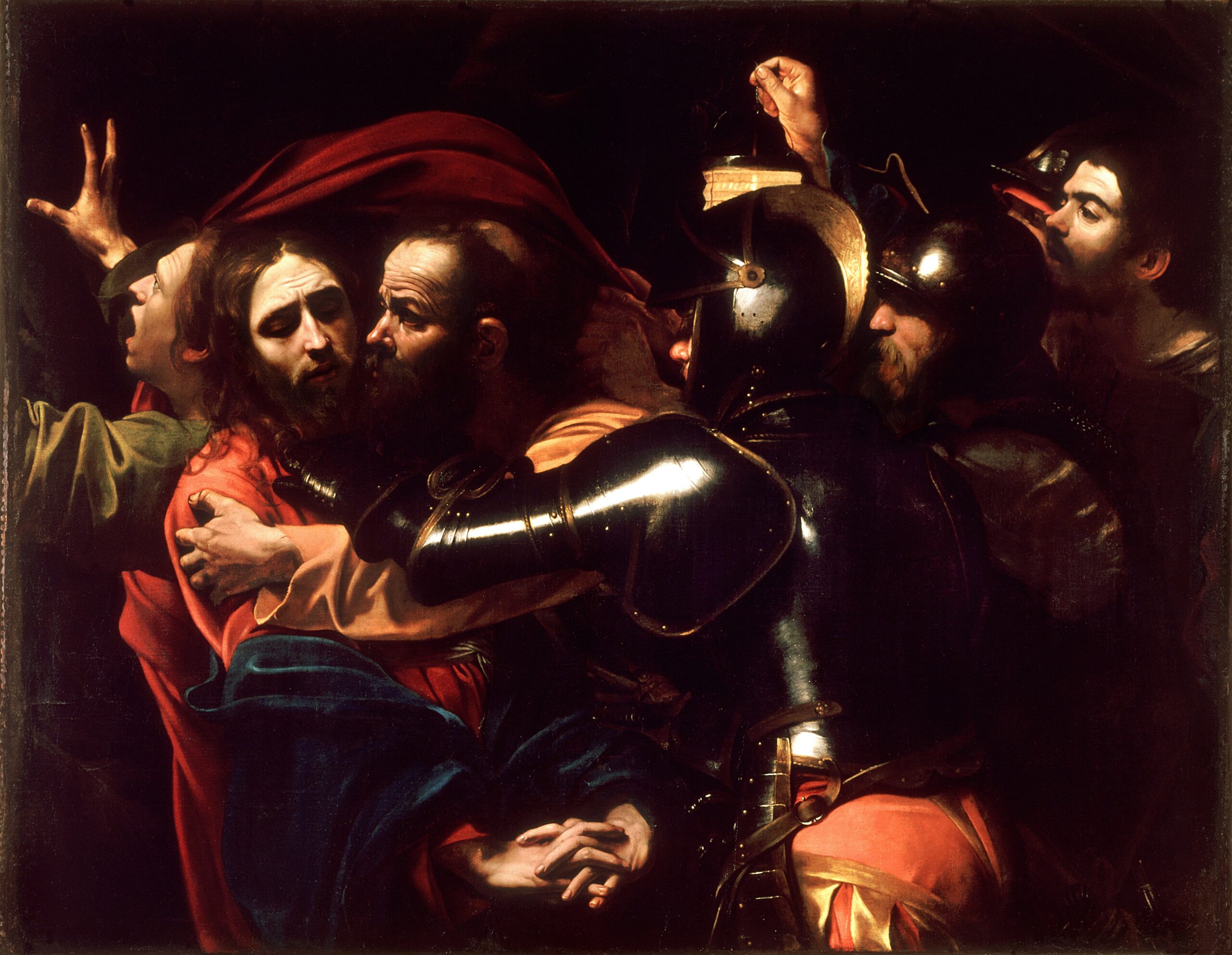
Movement 2 is episodic, with sections that flow into each other. First, the Evangelist begins the narrative with John chapter 18. Then Jesus has his first intervention. Bach gives Jesus’ text (“vox Christi”, “the voice of Christ”) to the bass, as usual, but interestingly he doesn’t add strings to accompany Jesus’ speech (creating a sort of “musical halo”) like he almost always did in his cantatas and in the St. Matthew Passion. The choir also makes its first appearance, impersonating the group of soldiers and servants of the priests and Pharisees that accompany Judas to capture Jesus. The highly energetic, almost frantic, musical material that accompanies the choir becomes a characteristic of these choral interventions depicting crowds (“turbae”).
After this first confrontation, the Biblical narrative pauses and we arrive at our first collective reflection. The choir switches persona and now sings a plain four-part chorale setting on behalf of the congregation. The text is stanza 7 of “Herzliebster Jesus, was hast du verbrochen” by Johann Heermann, of 1630.
The Evangelist continues with the story, and we witness Jesus telling Simon Peter to put his sword away after he cuts off Malchus’ ear. Jesus’ words prompt another chorale, a prayer for patience and restrain in times of suffering. The text is stanza 4 of Martin Luther’s “Vater unser in Himmelreich” (1539). This hymn is Luther’s paraphrase of “The Lord’s Prayer”.
Another Gospel segment follows, describing Jesus being bound and taken before Annas. This leads to the first aria in the Passion. Its text is a paraphrase of the first movement of the “Brockes Passion” libretto (“Der für die Sünde der Welt gemarterte und sterbende Jesus”), an extremely famous text published in 1712 that had been set to music by many well-known composers such as Keiser, Telemann, Händel, Mattheson, and others. The aria, written in the first person so the listener identifies with the singer, uses the image of Jesus’ bonds described in the Gospel as a metaphor for one’s sin. The B section includes a mention of the “sores of vice”, a very baroque, graphical image that connects with the wounds to be inflicted on Jesus.
Musically, Bach sets it for the alto, accompanied by two oboes and continuo. Its triple tempo and gentle, dance-like character opens a parenthesis on the abrupt and physical Gospel narrative. The intertwining oboe lines, sometimes imitative, sometimes parallel, can be thought of as illustrating “Stricken” (“bonds”). However, the overall affect is one of release, not captivity. The aria is da-capo, but through-composed: Bach restates the opening material with variants.