The Cantata Trail

A listening journey through Bach's vocal music

The birth of Christ

Christmas Oratorio, BWV 248
Part One: The birth of Jesus

The first cantata of the Christmas Oratorio is bright and celebratory. Bach opens it with instrumentation well suited for such a festive occasion: 3 trumpets and timpani, 2 flutes, 2 oboes, strings and basso continuo, with a 4-part choir. It is remarkable how the timpani and flutes take the lead, quickly followed in dizzying motion by the rest of the orchestra and then by the choir, who proclaim excitement and joy, urging the congregation to worship and celebrate God’s deed. This movement was sourced from the opening chorus of BWV 214, which, given its text, explains why the voices come in on musical motifs that resemble timpani and trumpets. In section B, Bach abandons the largely homophonic choral delivery of section A in favor of imitative textures and gives a break to the trumpets, before the movement loops around to repeat the initial segment.

After this expansive and joyful opening, the cantata is structured in two sets of four movements. Each set starts with a segment of Gospel narrative delivered by the Evangelist, continues with a recitative/aria pair, and closes with a chorale.

The first such group refers to the time just before Jesus’ birth. The Evangelist tells us of the journey of Joseph and Mary into Nazareth to be registered, and how the moment of Jesus’ birth arrived. The alto is in charge of the first reflection, with a recitative (accompanied by oboes d’amore) and aria that explore the rhetorical figure of Zion (Jerusalem, representing the Church) and Jesus as lovers to be soon betrothed. Bach changed the instrumentation of the original aria, sourced from BWV 213/9, adding an oboe d’amore in unison with the violin. The chorale that closes this first segment is the title stanza of “Wie soll ich dich empfangen” by Paul Gerhardt, of 1653, set to four-part harmony with the instruments doubling the voices.

The next set of four movements deal with Jesus’ birth. The Evangelist picks up the biblical narrative with the verses from Luke that describe the birth of Jesus and his refuge in the manger. The following movement is a combination of a chorale melody, given to the sopranos, with recitative insertions by the solo bass. The voices are accompanied by the two oboes d’amore and continuo. The soprano line is a stanza of the chorale “Gelobet seist du, Jesu Christ,” by Martin Luther, of 1524, while the bass recites original poetry. The two voices jointly meditate on the coming of Jesus in poverty, as the savior of humanity, to offer us the riches of Heaven. This reflection leads to a spectacular bass da-capo aria with solo trumpet (sourced from BWV 214/7), a combination frequently employed by Bach and other Baroque composers in celebratory circumstances. The orchestration also includes flute (added to the parody in unison to the first violin) and strings, and the text continues to elaborate on God’s disdain for earthly pomp in sending the Savior to a manger.

The cantata closes with a chorale interspersed with fanfares from the trumpets and timpani, with text in the first person that celebrates the arrival of Child Jesus and offers the heart of the faithful as his resting place. The text comes from “Vom Himmel hoch, da komm ich her” by Martin Luther of 1535.
1. Chor
Jauchzet, frohlocket! auf, preiset die Tage,
Rühmet, was heute der Höchste getan!
Lasset das Zagen, verbannet die Klage,
Stimmet voll Jauchzen und Fröhlichkeit an!
Dienet dem Höchsten mit herrlichen Chören,
Lasst uns den Namen des Herrschers verehren!
1. Chorus
Rejoice, exult! Arise, glorify the day,
Praise what the Highest has done today!
Let fear fall away, banish lamenting,
Strike up songs of rejoicing and gladness!
Serve the Highest with glorious choirs,
Let us honor the name of the Lord!
2. Rezitativ (T)
EVANGELIST
Es begab sich aber zu der Zeit, dass ein Gebot von dem Kaiser Augusto ausging, dass alle Welt geschätzet würde. Und jedermann ging, dass er sich schätzen ließe, ein jeglicher in seine Stadt. Da machte sich auch auf Joseph aus Galiläa, aus der Stadt Nazareth, in das jüdische Land zur Stadt David, die da heißet Bethlehem; darum, dass er von dem Hause und Geschlechte David war: auf dass er sich schätzen ließe mit Maria, seinem vertrauten Weibe, die war schwanger. Und als sie daselbst waren, kam die Zeit, dass sie gebären sollte.
2. Recitative (Tenor)
EVANGELIST
And it came to pass in those days that a decree went out from Caesar Augustus that the whole world should be enrolled. And everyone went to be enrolled, each to his own city. So Joseph also went up from Galilee, from the city of Nazareth, to Judea, to the city of David, which is called Bethlehem, because he was of the house and lineage of David, to be enrolled with Mary, his betrothed wife, who was pregnant. And while they were there, the time came for her to give birth.
(Luke 2: 1, 3-6)
3. Rezitativ (A)
Nun wird mein liebster Bräutigam,
Nun wird der Held aus Davids Stamm
Zum Trost, zum Heil der Erden
Einmal geboren werden.
Nun wird der Stern aus Jakob scheinen,
Sein Strahl bricht schon hervor.
Auf, Zion, und verlasse nun das Weinen,
Dein Wohl steigt hoch empor!
3. Recitative (Alto)
Now my dearest bridegroom,
Now the hero from David’s line
Will once be born
As comfort and salvation to the world.
Now the star from Jacob will shine,
Its light already breaks forth.
Arise, Zion, and stop your weeping,
Your joy is rising high!
4. Aria (A)
Bereite dich, Zion, mit zärtlichen Trieben,
Den Schönsten, den Liebsten bald bei dir zu sehn!
Deine Wangen
Müssen heut viel schöner prangen,
Eile, den Bräutigam sehnlichst zu lieben!
4. Aria (Alto)
Prepare yourself, Zion, with tender emotions,
To behold the fairest, the dearest one near you!
Your cheeks
Must glow with greater beauty today,
Hurry to love your bridegroom with longing!
5. Choral
Wie soll ich dich empfangen
Und wie begegn' ich dir?
O aller Welt Verlangen,
O meiner Seelen Zier!
O Jesu, Jesu, setze
Mir selbst die Fackel bei,
Damit, was dich ergötze,
Mir kund und wissend sei.
5. Chorale
How shall I receive you
And how shall I meet you?
O desire of all the world,
O ornament of my soul!
O Jesus, Jesus, set
A torch within me,
So that what delights you
May be known and understood by me.
6. Rezitativ (T)
EVANGELIST
Und sie gebar ihren ersten Sohn und wickelte ihn in Windeln und legte ihn in eine Krippen, denn sie hatten sonst keinen Raum in der Herberge.
6. Recitative (Tenor)
EVANGELIST
And she gave birth to her firstborn son, and wrapped him in swaddling cloths and laid him in a manger, because there was no room for them in the inn.
(Luke 2: 7)
7. Choral (S); Rezitativ (B)
SOPRAN
Er ist auf Erden kommen arm,

BASS
Wer will die Liebe recht erhöhn,
Die unser Heiland vor uns hegt?

SOPRAN
Dass er unser sich erbarm,

BASS
Ja, wer vermag es einzusehen,
Wie ihn der Menschen Leid bewegt?

SOPRAN
Und in dem Himmel mache reich,

BASS
Des Höchsten Sohn kömmt in die Welt,
Weil ihm ihr Heil so wohl gefällt,

SOPRAN
Und seinen lieben Engeln gleich.

BASS
So will er selbst als Mensch geboren werden.

SOPRAN
Kyrieleis!
7. Chorale (Soprano); Recitative (Bass)
SOPRANO
He came to earth in poverty,

BASS
Who can rightly praise the love
That our Savior holds for us?

SOPRANO
So that he might show us mercy,

BASS
Yes, who can comprehend
How the suffering of mankind moved him?

SOPRANO
And make us rich in heaven,

BASS
The Son of the Highest comes into the world,
Because our salvation delights him so,

SOPRANO
And like his beloved angels.

BASS
He himself will be born as a man.

SOPRANO
Lord, have mercy!
8. Aria (B)
Grosser Herr, o starker König,
Liebster Heiland, o wie wenig
Achtest du der Erden Pracht!
Der die ganze Welt erhält,
Ihre Pracht und Zier erschaffen,
Muss in harten Krippen schlafen.
8. Aria (Bass)
Great Lord, O mighty King,
Dearest Savior, how little
You regard the glory of the earth!
He who upholds the entire world,
Who created its splendor and beauty,
Must sleep in a rough manger.
9. Choral
Ach mein herzliebes Jesulein,
Mach dir ein rein sanft Bettelein,
Zu ruhn in meines Herzens Schrein,
Dass ich nimmer vergesse dein!
9. Chorale
Ah, my heart’s beloved little Jesus,
Make yourself a pure, soft bed
To rest in the shrine of my heart,
So that I never forget you!

Ruth Ziesak, soprano
Monica Groop, alto
Christoph Prégardien, tenor
Klaus Mertens, bass
Vokalensemble Frankfurt
Concerto Köln
Ralf Otto

Viola Blache, soprano
Ulrike Malotta, alto
Daniel Johannsen, tenor
Matthias Helm, bass
Netherlands Bach Society
Shunske Sato, violin and direction

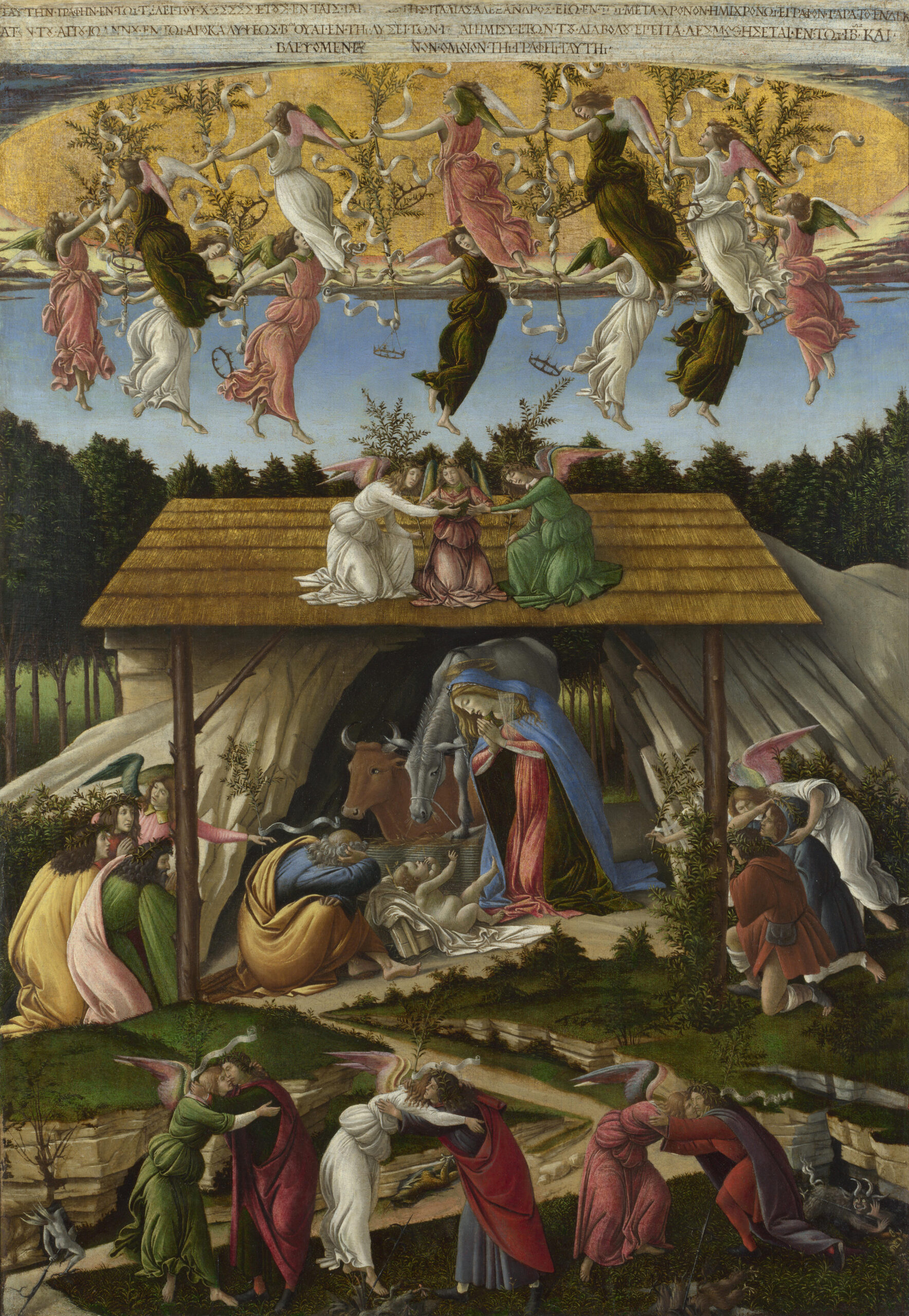
Mystic Nativity

Sandro Botticelli (1500-1501)

Movements

1. Chorus
2. Recitative (Tenor)
3. Recitative (Alto)
4. Aria (Alto)
5. Chorale
6. Recitative (Tenor)
7. Chorale (Soprano); Recitative (Bass)
8. Aria (Bass)
9. Chorale

Performers

Ruth Ziesak, soprano
Monica Groop, alto
Christoph Prégardien, tenor
Klaus Mertens, bass
Vokalensemble Frankfurt
Concerto Köln
Ralf Otto