“Gottes Zeit ist die allerbeste Zeit”, BWV 106, reigns supreme among the handful of early (pre-Weimar) Bach cantatas that have come down to us. While we don’t have any original materials dating from the time of its composition (or from any time during Bach’s lifetime, for that matter), a copy of the score made in 1768 by an unknown copyist (referred to as “Anon 421” by Bach scholarship) is the reason the work was preserved for posterity. We are all incredibly grateful to that anonymous scribe!
The cantata is thought to have been composed during the year that Bach spent in Mühlhausen as an organist at St. Blasius’ Church or “Divi-Blasii-Kirche” (mid-1707 to mid-1708). However, given the lack of original materials, this dating is conjectural, based on characteristics of its music and libretto. There isn’t any hard evidence as to the occasion for its composition, either. Given that the work deals with the subject of death, the prevailing opinion is that it was written for a funeral, and scholars and historians have put forward several possibilities as to who the deceased person could have been. In an effort to approach the piece with fresh eyes, some authors have proposed the interesting viewpoint that the cantata could have been intended as a reflection on death, but not necessarily tied to a funeral.
The libretto pieces together text from several sources. Just last year, musicologist Markus Rathey discovered that the opening movement comes from “Hundert Evangelische Todes-Gedancken” by theologian David von Schweinitz (1600-1667), a popular and widely distributed compilation of Gospel commentaries related to death published in 1664. The source of the cantata movement is the opening of commentary number 23 in this volume, which addresses the Gospel reading for the Feast of Purification of Mary. Movements 2 and 3 are a “collage” of biblical quotations, most of which can be found in a prayer book of 1672, “Christliche Bet-Schule”, by Johann Olearius (1611–1684), some of whose publications Bach owned. The cantata also incorporates two chorale texts: the first stanza of “Mit Fried und Freud ich fahr dahin”, Martin Luther’s paraphrase of the Song of Simeon or Nunc Dimittis (Luke 2: 29-32) dating from 1524, and the seventh stanza of “In dich hab’ ich gehoffnet, Herr” by Adam Reusner, of 1533. Both chorales are also included in Olearius’ prayer book.
Even as sourcing the text from so many disparate sources, the unknown librettist (possibly Bach himself?) took great care to create a structure that provides a strong and well-articulated message aligned with the Lutheran perspective on death. Its inevitability is highlighted in the first half of the libretto, through the Old Testament quotes that comprise movement 2, ending with the lapidary “you must die!”. Then, at the center, is the invocation “Ja, komm, Herr Jesu, komm!”, which shifts the tone dramatically. We now look at the believer’s redemption, Jesus’ promise of Paradise, and Simeon’s serene and joyful acceptance of death as “sleep”, culminating in our victory over death through Jesus Christ.
The work is scored for two recorders, two violas da gamba, basso continuo and four voices (SATB). This instrumentation has strong affinity with sacred (and funeral) music in 17th century Germany. Even after being exposed to Italian influences in Weimar and adopting different orchestral configurations, Bach brought back some of this sonority in later, Leipzig-era works dealing with the topic of death, such as the “Trauer-Ode” (BWV 198) or even the Passions.
The Sonatina that opens the cantata juxtaposes two pairs of instruments over a basso continuo line: two violas da gamba and two recorders. The tempo marking is “Molto adagio” – “very slow”. The basso continuo moves in slow eighths on repeated pitches throughout the movement, creating a relentless but calm pulsing, as if illustrating the passing of time. On top of it, the two gambas adopt the same cadence, but they incorporate a bit more movement with sighing motifs in occasional passages, particularly before the recorders come in. Their combined effect is warm, dark and grainy, invoking the inevitability of death that the first part of the libretto refers to. Four bars in, the two bright recorders come in together, collaborating on a single line which they make to pulse with life, via a couple of mechanisms: doubling up on sections of the melody versus leaving other bits to just one of them, and time shifting ornamental up or down movements on certain notes. It’s a magical, almost hypnotic effect that can be seen as representing the hopeful, serene joy of death as portrayed in the second half of the libretto.
The next movement is an episodic structure that covers the von Schweinitz text (in itself consisting of three segments), plus the quotes from Psalm 90, Isaiah, Ecclesiasticus and Revelation, via distinct musical sections that flow into each other:
- 2a. The opening statement, “Gottes Zeit…”, set as a chorus, features an energetic, broken arpeggio theme initially stated by the sopranos, eliciting a homophonic response from the other voices. For the second verse, “In ihm leben…” (a quote from the book of Acts), Bach shifts into a ternary tempo marked “allegro” and creates a lively fugal texture with the four voices imitating each other, illustrating the “live, move” ideas of the text. The word “solange” (“as long as”) is depicted via a 3-bar long held note on the sopranos, echoed by the recorders. This flows into a common-time “adagio” for a more somber and dramatic sound on the final words of the segment, which now mention death. The final “when he wills” is highlighted by a collective rest in the voices and an ornament on the recorders, just before it.
- 2b. Then the tenor, still in common time and in a “Lento” tempo marking, delivers the Psalm 90 quote, a soulful and lyrical prayer for wisdom, accompanied by all the instruments on top of an “ostinato” bass line.
- 2c. For the Isahiah line, which prompts the listener into action (“Put your house in order…”), Bach shifts to a “Vivace” triple meter and has the recorders in unison on restless strings of arpeggios on top of a continuo line peppered with energetic rests. The gambas are quiet, and the bass delivers the authoritative command with the urgency of a true “call to action”.
- 2d. To close out the movement, the tempo slows down one more time to “Andante” and the Ecclesiasticus quote is presented by the choir supported only by the basso continuo. Interestingly, only the three lower voices (supported by the continuo) take part in the fugue. The sopranos are quiet for two expositions of the subject, and then a solo singer interrupts with the quote from Revelation (“Ja, komm, Herr Jesu, komm!”) – the inflection point of the narrative. In turn, that leads to the entrance of the instruments, who insert a four-part harmonization of a chorale tune associated with the hymn “Ich hab mein Sach Gott heimgestellt” (Johann Leon, 1589), a text that also reflects on death and resonates extremely closely with the ideas set forth in the cantata libretto. The three elements (choral fugue, soprano invocation and instrumental chorale) continue to interplay until the instruments and voices start withdrawing successively – first the recorders, then the lower voices of the choir, then one of the gambas, then the other, and finally the continuo. This leaves the soprano completely alone on its final plea to Jesus. The movement ends with an empty bar with a fermata – a long pause which marks the rhetorical pivot point of the libretto.
Similarly, movement 3 is also segmented, this one into two sections:
- 3a. The first element is an alto aria, accompanied only by the basso continuo, on the quote from Psalm 31 – the believer committing to God and praying for redemption. The continuo line’s almost ostinato motif opens with a raising scale over an octave and a half, possibly illustrating the idea of the believer’s spirit reaching up to God. This scalic pattern is also employed later by the voice, on the words “in deine Hände” (“into your hands”).
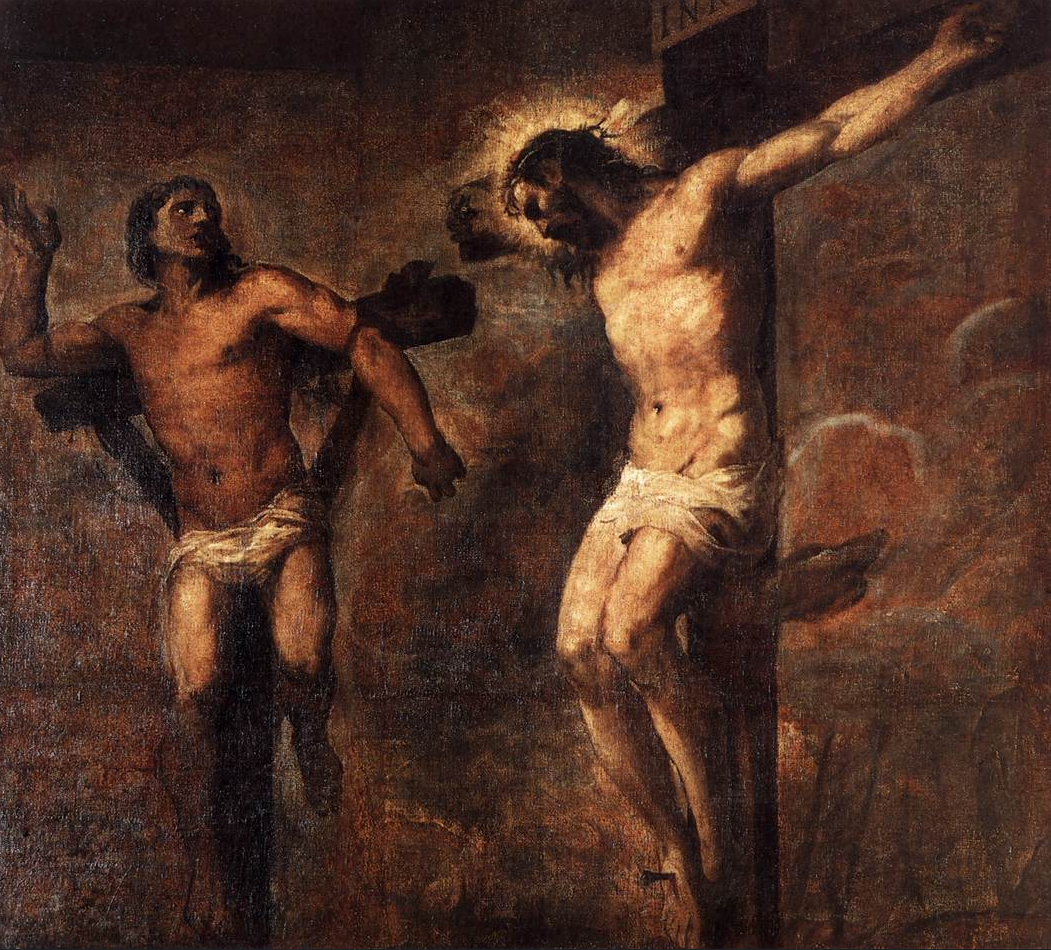
- 3b. The aria flows directly into the bass arioso and chorale. For the quote of Luke 43: 23 (Jesus’ promise to the good thief crucified next to him that they will meet in Paradise “today”), Bach as usual gives Jesus’ words to the bass (vox Christi). He repeats “Heute” (“today”) twice every time the quote is uttered, and sets “Paradise” to a motif that starts with a wide upward leap onto a long note, syncopated into the next beat. The continuo line becomes imitative, playing off of the bass’ material. Shortly, the alto (or choir altos together) comes back to insert the intonation of Luther’s chorale, the Song of Simeon (“Mit Fried und Freud…”), on top of the bass’ aria. The violas de gamba join the alto, alternating ornamental short motifs of three sixteenth notes and a quarter, sometimes arranged in an ascending pattern, sometimes descending. Fluttering angelic wings leading everybody to Paradise? With a final upward flourish, the bass concludes his line, letting the alto deliver the final verses of the chorale stanza (“As God has promised me, death has become my sleep”) with the gambas and continuo. The word “sleep” (“Schlaf”) is marked “piano” on the score for the voice and all the instruments, as was “stille” (“quiet”) before.
After this dense and intricate weave, we arrive at the closing chorale. Bach foreshadows what would become one of his favorite choral movement architectures: a bipartite structure consisting of a free-form initial section followed by a fugue. In this case, he chooses to set the first five lines of Reusner’s hymn stanza in plain four-part harmonization, with the full instrumental contingent providing a short introduction, ornamenting the delivery of the lines on top of the voices, and bridging the lines with short instrumental episodes. For the final line (“Durch Jesum Christum, Amen.”), he deploys an extensive fugue. The main subject, which starts with five quarter notes, is set to the words “Durch Jesum Christum”, and is always accompanied by the countersubject, an ascending run of sixteenths to the word “Amen”. After a first set of entrances with the voices supported only by the continuo, the instruments start doubling the upper voices – the two recorders with the sopranos, one viola with the altos and the other one with the tenors. The final entry of the subject is augmented to half notes on the sopranos, leading to a final round of homophonic “Amen’s” on all the voices. The final “Amen” is not sung, but delivered by the recorders and gambas alone.