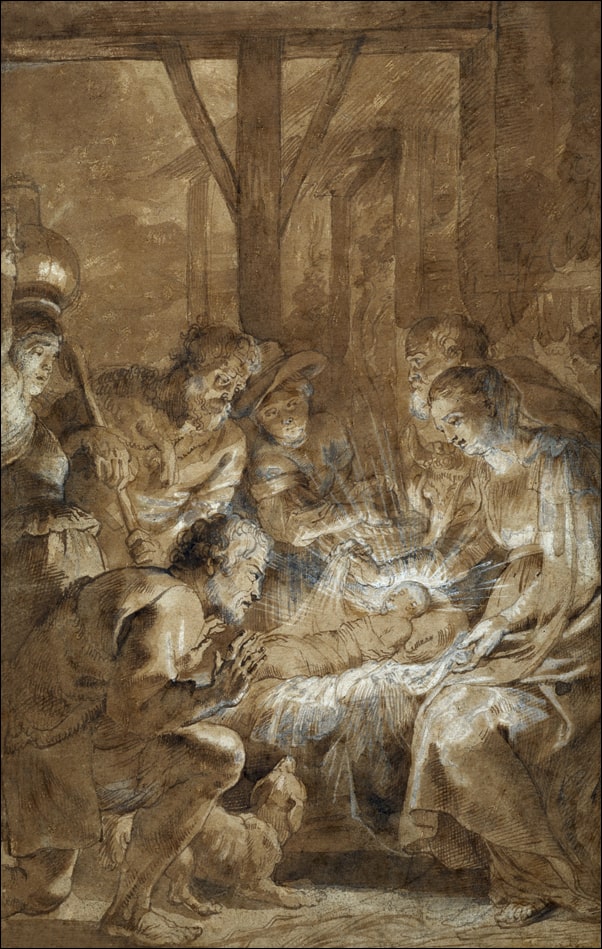
The third part of the Christmas Oratorio opens again with a festive chorus, orchestrated with full forces (trumpets, timpani, flutes, oboes, strings and basso continuo). The text is an expression of joy and praise that frames the story narrated in this part: the shepherds going to find Child Jesus and worship him. The chorus will be repeated in full at the closing of the cantata, in the manner of a “da capo”. The music for this movement comes from the closing movement of BWV 214.
After the opening chorus, the Evangelist begins the narrative, with a quote from the Gospel of Luke (chapter 2, first part of verse 15) that introduces the shepherds after the angels disappear. The choir takes on the role of the shepherds as they decide to go to Bethlehem. The music, very effectively, paints their excitement and nervousness with a “moto perpetuo” motif on the two flutes and first violins in unison, on top of a walking bass line mostly in eighths. The text of the chorus is the remainder of Luke’s verse 15.
Next, a recitative for the bass, accompanied by the flutes, reflects on the consolation and salvation represented by Jesus, and encourages the shepherds to set out on their way. The choir, now representing the community, responds to the bass’s reflection and offers a chorale of thanksgiving with the orchestra doubling the voices. The text and its associated melody come from “Gelobet seist du, Jesu Christ” by Martin Luther. We first encountered this tune (and text from a different stanza) in Part 1, movement 7 interspersed with the bass recitative.
The following movement, a duet accompanied by two oboes d’amore, was sourced from BWV 213/11. The libretto reflects on God’s compassion, grace and love. The imitative and intertwined lines, cast to soprano and bass, suggest the intimacy of the Soul of the believer with Jesus. In the original, this movement is a love duet between Hercules and Virtue, set for alto and tenor, with the very sensuous accompaniment of two violas, in the key of F major. Bach transposed the piece to A major and replaced the violas with the oboes.
The next movement, a recitative for the Evangelist, picks up Luke’s narration. Verses 16 to 18 from chapter 2 describe the arrival of the shepherds at the manger and the reaction of those present as the shepherds tell their story. The last verse (19) of the Gospel quote mentions how Mary “treasured up all these events, reflecting on them in her heart.”
This leads to an alto aria with solo violin, which is considered the only original aria of the Oratorio. Scholars believe that Bach had in mind an aria from BWV 215 for this movement, but later decided against using it and composed fresh music instead. The aria’s intimate orchestration points to the personal and inward nature of the text, in which Mary speaks to her heart stating that these events will strengthen her faith. It is interesting to observe how the voice and violin come together in unison on the words “fest in deinem Glauben ein” (“firm in your faith”) in bars 35, 55-57, and 113.
After the aria, the alto summarizes the same ideas with a recitative, which like the bass one before is accompanied by the flutes. Then the choir, representing the congregation, sings a chorale in two stanzas contrasting earthly life with eternal life. The text is a verse from a hymn by Paul Gerhardt from 1653, most likely chosen due to the reference to “safeguarding” Jesus in the believer’s heart.
The evangelist offers the last quotation from Luke in this cantata (chapter 2, verse 20), recounting the return of the shepherds to the fields, and the choir follows with a chorale on a text by Christoph Runge of 1653. In his setting of the chorale, Bach inserts a subtle illustration of the word “froh” (joy) with ascending sixteenth notes on the bass line.
The cantata closes with the repetition of the opening chorus.