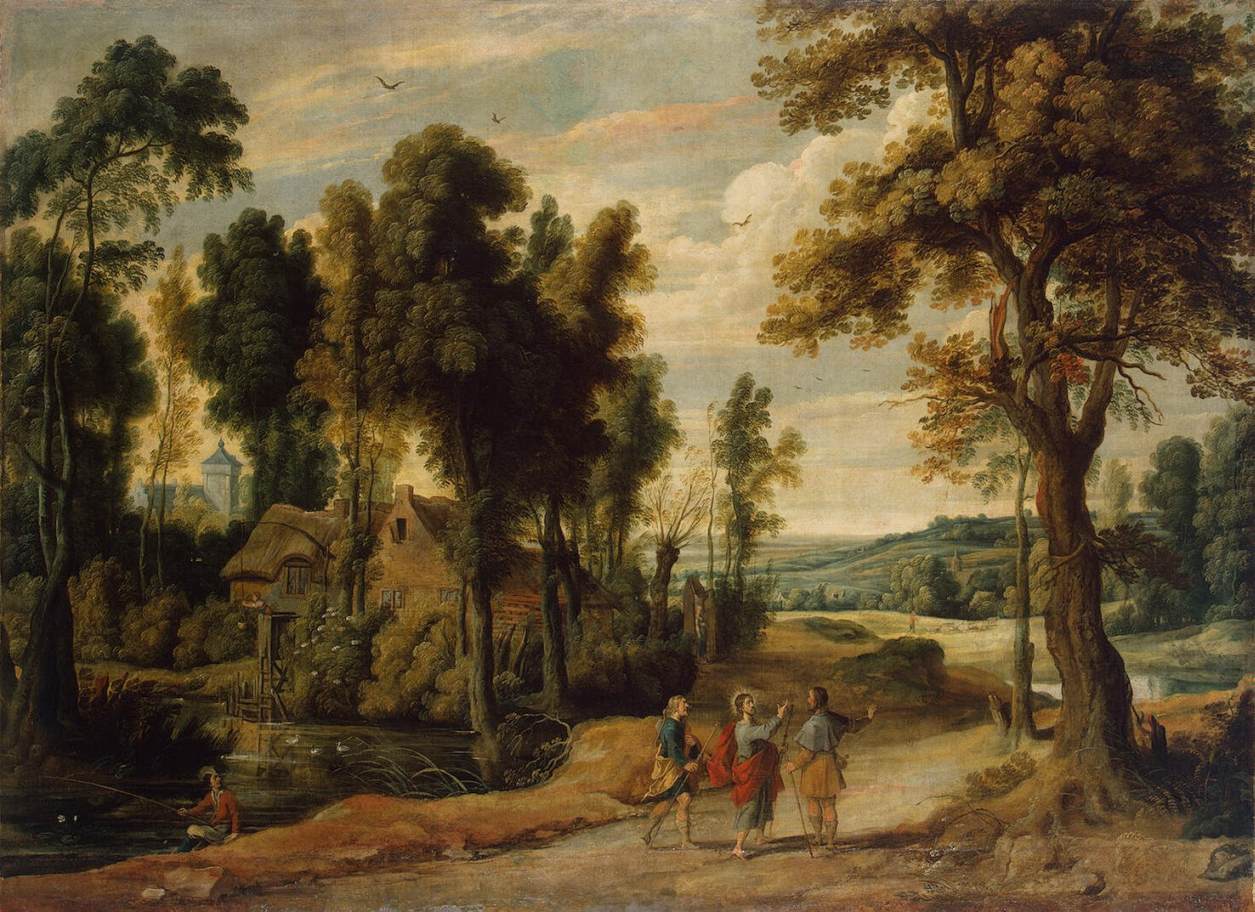
“Bleib bei uns, denn es will Abend werden”, BWV 6, is a cantata for Easter Monday composed by Bach for performance on April 2, 1725, about two years into his tenure at Leipzig. Chronologically, this places it just after his cycle of “chorale cantatas” breaks off on Easter Sunday that year. A second performance has been documented by scholars and dated in the late 1730s.
The readings for this feast (second day of Easter) are Acts 10: 34-43 and Luke 24: 13-35. The libretto, by an unidentified poet, picks up verse 29 from the Luke segment, in which the two disciples ask the just-resurrected Jesus (whom they haven’t recognized yet) to stay with them for the night. This quote is inserted verbatim as the opening movement. The rest of the libretto, without getting involved in other elements of the story, elaborates on the concept of light versus darkness, equating Jesus with the former. Movements 3 and 6 are chorales: the first two stanzas of “Ach bleib bei uns, Herr Jesu Christ” by Nikolaus Selnecker, of 1611, and stanza 2 of “Erhalt uns, Herr, bei deinem Wort” by Martin Luther, of 1542, respectively.
The cantata is orchestrated for two oboes, strings and continuo, with the notable additions of an oboe da caccia and violoncello piccolo. Vocally, it requires a four-part choir plus alto, tenor and bass soloists.
Bach sets up the first movement as an imposing and contemplative multi-section chorus. It starts in a slow triple meter, with a sarabande-like motif reminiscent of that of the closing chorus of his St. John Passion (which had just been performed for the second time). The three oboes depict the pleading of the Gospel quote via a descending leap, while the strings add urgency and insistence to the request with their strings of eighths in unison on a steady pitch. The voices enter homophonically on the pleading motif. As the structure unfolds, the pleading goes to the strings while the oboes take on the repeated, insistent pitches. The middle section switches to a fugal structure in binary meter and initially drops all instruments except for the continuo. The text is restated from the beginning, but broken up such that the words “bleib bei uns” are set to a new version of the single pitch insistent motif – now in two half notes and one whole – which travels across the voices serving as countersubject to the fugal theme, set to the remainder of the quote. The instruments enter a few bars into the fugue, largely doubling the voices. A short section closes the movement by going back to the original material.
The first aria, for alto accompanied by the oboe da caccia and continuo, is a prayer to Christ to “remain our light” against the evening’s “darkness breaking in”. The main motif opens with an arpeggiated upward sixth, a typical illustration of longing or anguish. It’s first stated by the oboe and then twice by the voice, in the “motto aria” setup by which the voice states the motivic material only to be interrupted by a few more bars of instrumental ritornello, before restating the theme and carrying on.
This leads to the first chorale setting of the cantata, set to Selnecker’s text. It’s an elaborate construct with the hymn tune on slow notes given to the soprano, while the violoncello piccolo waves an intricate line around it, both supported by the basso continuo. Bach transcribed this movement for organ as part of the “Schübler Chorales” collection published in the late 1740s.
The secco bass recitative that follows reflects on the source of darkness: acting against Christian duty. It closes with a reference to “overturning the lampstand” (from Revelation 2: 5). It’s followed by a tenor aria with strings and continuo, whose text prays to Jesus again, now asking for the “light of [his] Word” to prevent us from walking the “paths of sin” (presumably a reference to the road to Emmaus, setting of the Gospel story). One could hear the leapy, angular theme in eights, the scalic sextuplets of sixteenths, and the sighing dactylic patterns as a representation of the confused, aimless walking while praying longingly.
The cantata closes with its second chorale setting, a simple four-part harmonization of Luther’s stanza with the instruments doubling the voices.