[Oratorio…] The musical composition must be rich in everything that art can muster
in terms of ingenious and refined ideas.
Johann Gottfried Walther, Musikalisches Lexicon (1732)
Bach composed his Weihnachts-Oratorium for the 1734/35 Christmas season in Leipzig. His intention was not to perform it completely on one occasion, but to structure it as a cycle of six cantatas for the different feast days between Christmas and Epiphany, integrated into the religious services at the St. Thomas and St. Nicholas churches. However, only at St. Nicholas was the oratorio heard in its entirety for its inaugural presentation, as parts 3 and 5 were not performed at St. Thomas. We don’t know for sure whether the Oratorio was presented again in later years, either in full or individual cantatas, although it’s hard to imagine that Bach would have shelved it after using it for just one Christmas season.
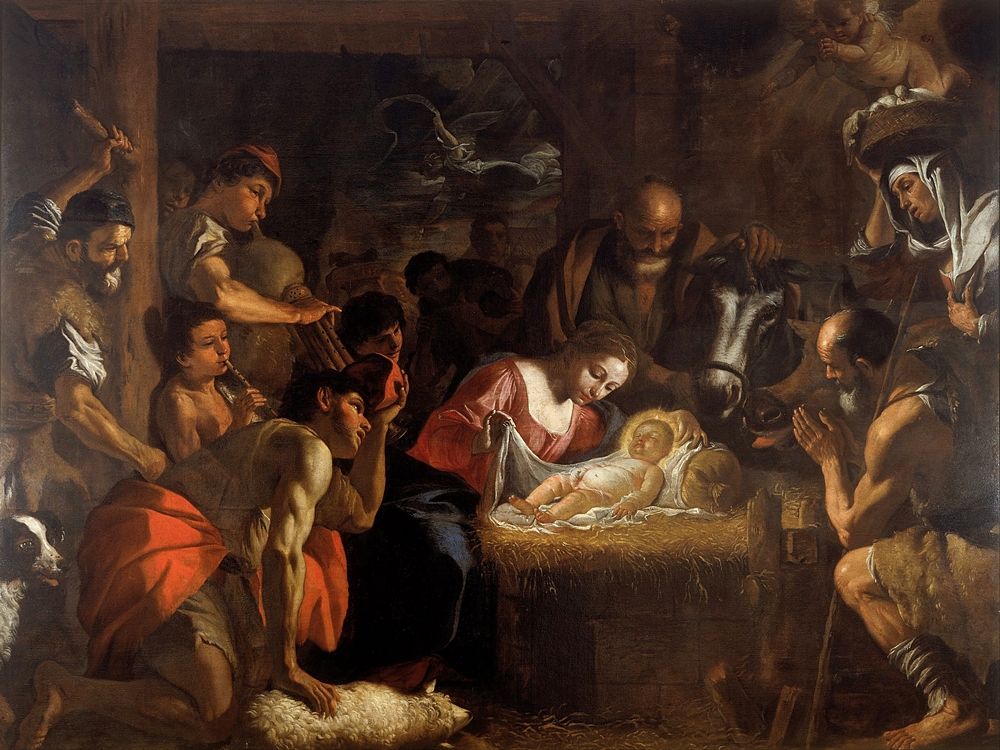
Each of the six parts illustrates a section of the Nativity story:
Part 1: Christmas Day – The birth of Jesus
Part 2: Second Day of Christmas – The annunciation to the shepherds
Part 3: Third Day of Christmas – The adoration of the shepherds
Part 4: New Year’s Day – Circumcision and naming of Jesus
Part 5: First Sunday of the year – The journey of the Magi
Part 6: Feast of Epiphany (January 6) – The adoration of the Magi
The oratorio includes the soloist roles of the Evangelist, the Angel, and Herod. At different points throughout the narrative the choir impersonates the angels, the shepherds, and the Magi. However, compared to the Passions, the libretto is noticeably less dramatic. To compensate for this relative levity, Bach gives each cantata a very distinct character, painting different vignettes through musical language, form and instrumentation. Walther’s quote above is certainly fitting!
One aspect of the Christmas Oratorio that attracts lots of research and analysis is that Bach, through a process known as “parody”, reused previously composed music, masterfully adapting it to the new context. His sources were all very recent compositions: three secular cantatas (preserved) and one church cantata, which is unfortunately lost:
- “Laßt uns sorgen, laßt uns wachen”, or “Hercules at the crossroads”, BWV 213 – an homage cantata for the 11th birthday of Prince Friederich Christian of Saxony, with text by Picander. (September 1733)
- “Tönet, ihr Pauken! Erschallet, Trompeten!”, BWV 214 – another birthday piece, this time for Maria Josepha, Queen of Poland and Electress of Saxony. Unknown librettist. (December 1733)
- “Preise dein Glücke, gesegnetes Sachsen”, BWV 215 – Festive music for the anniversary of the election of August III, Elector of Saxony, as King of Poland. Text by Johann Christoph Clauder, professor at the University of Leipzig. (October 1734)
- A lost cantata for the feast of St. Michael (Michaelmas) in September 1734, which has the catalog number BWV 248a. It was parodied in its entirety into Part 6 of the Oratorio.
The Christmas Oratorio’s libretto is most likely by Picander (Christian Friedrich Henrici), a frequent Bach collaborator in Leipzig, who drew on sections of the Gospels of Luke for cantatas 1 through 4 (chapter 2, verses 1-21) and Matthew for cantatas 5 & 6 (chapter 2, verses 1-12). Between the segments of biblical narration, he interspersed poetic texts and chorale stanzas to serve as points of emphasis and reflection throughout the story.
As part of the parody process, several movements of the source cantatas listed above became movements in the Oratorio, for which Picander wrote new madrigalian poetry. The poet had the very difficult task of writing new movements for the Oratorio libretto to match the general tone and mood of the original stanzas from the source cantatas. The original meter and rhyme had to be preserved, and it was also necessary to ensure that the musical illustrations that Bach had created for the original words would still be effective with the new language.
Bach, meanwhile, adapted the music in different ways: casting it to different voices via transposition, or changing affects or colors by altering orchestration, phrasings or articulations. In some cases, the “B” sections of da-capo movements were significantly re-composed.
Setting aside Part 6, in total there are eleven choruses and arias that were parodied: three in Part 1, two in Part 2, two in Part 3, three in Part 4, and one in Part 5. Generally speaking, movements with text expressing praise, celebration and reverence were sourced from similarly-themed movements in cantatas BWV 214 and 215, which are celebratory cantatas for royalty. For texts expressing more reflective or inward-looking concepts, or those referencing baby Jesus directly, the music was sourced from BWV 213, whose topic is a young character – Hercules, as a proxy for the 11-year-old Prince Friederich Christian.
Part 6 is believed to be a full repurposing of a church cantata (BWV 248a) composed in September 1734 for the feast of St. Michael (Michaelmas). We don’t have the cantata’s original libretto, so it’s hard to tell to what extent its text was adapted to fit the Oratorio narrative. Only some instrumental parts of the cantata survived (violin 1/2, basso continuo, and organ). They were discovered bundled together with the performance materials of the Oratorio and match the oratorio materials very closely.
In addition of reusing the eleven movements mentioned above through the parody process, and adapting the Michaelmas cantata, Bach composed a very significant amount of new music for the Oratorio: one solo aria (No. 31 in Part 3) and one trio (No. 51 in Part 5), all of the Evangelist and madrigalian recitatives, the choruses that are part of the biblical narrative, the sinfonia of Part 2, the opening chorus of Part 5, and all the chorales.