When Bach turned to the Mass as a musical genre, he was engaging with a tradition that already stretched back for centuries.
The text of the Mass took shape gradually going back to the early centuries of Christianity. The “Ordinary of the Mass” (i.e., the fixed texts that are recited in every service – Kyrie, Gloria, Credo, Sanctus and Agnus Dei) entered the liturgy at different stages between antiquity and the early Middle Ages. In medieval times, the texts were sung regularly in chant. Eventually they became one of the principal vehicles for polyphonic music, with composers such as Dufay, Josquin and Palestrina making the Mass a major genre in the Renaissance. During the 17th century, composers began to break up the text of the Mass into smaller sections, setting them as individual movements to more modern musical styles (adopted from new genres such as the opera and the concerto) alongside the old-fashioned language of the Renaissance stile antico.
In his Mass in B minor, Bach is deliberately integrating a wide variety of musical styles and languages, combining archaic counterpoint, concertato textures, arias, dance rhythms and of course his signature, masterful fugal writing, in a way that results in a coherent and harmonious whole, closely matched to the theological character of the text.
As part of this process, Bach reworked some of his finest cantata music using a technique called “parody”: the adaptation of an existing movement to a new text and context. These transformations were often substantial, amounting to a true “recomposition”, not simple reuse. He adapted vocal lines, orchestration, keys, episodic passages, and more, to ensure a seamless fit for the original material in its new place. In some cases, the affinity between the original cantata movement and the revised version in the Mass was dictated by their respective texts, a fact that highlights Bach’s trademark sensibility and care for setting the written word in music.
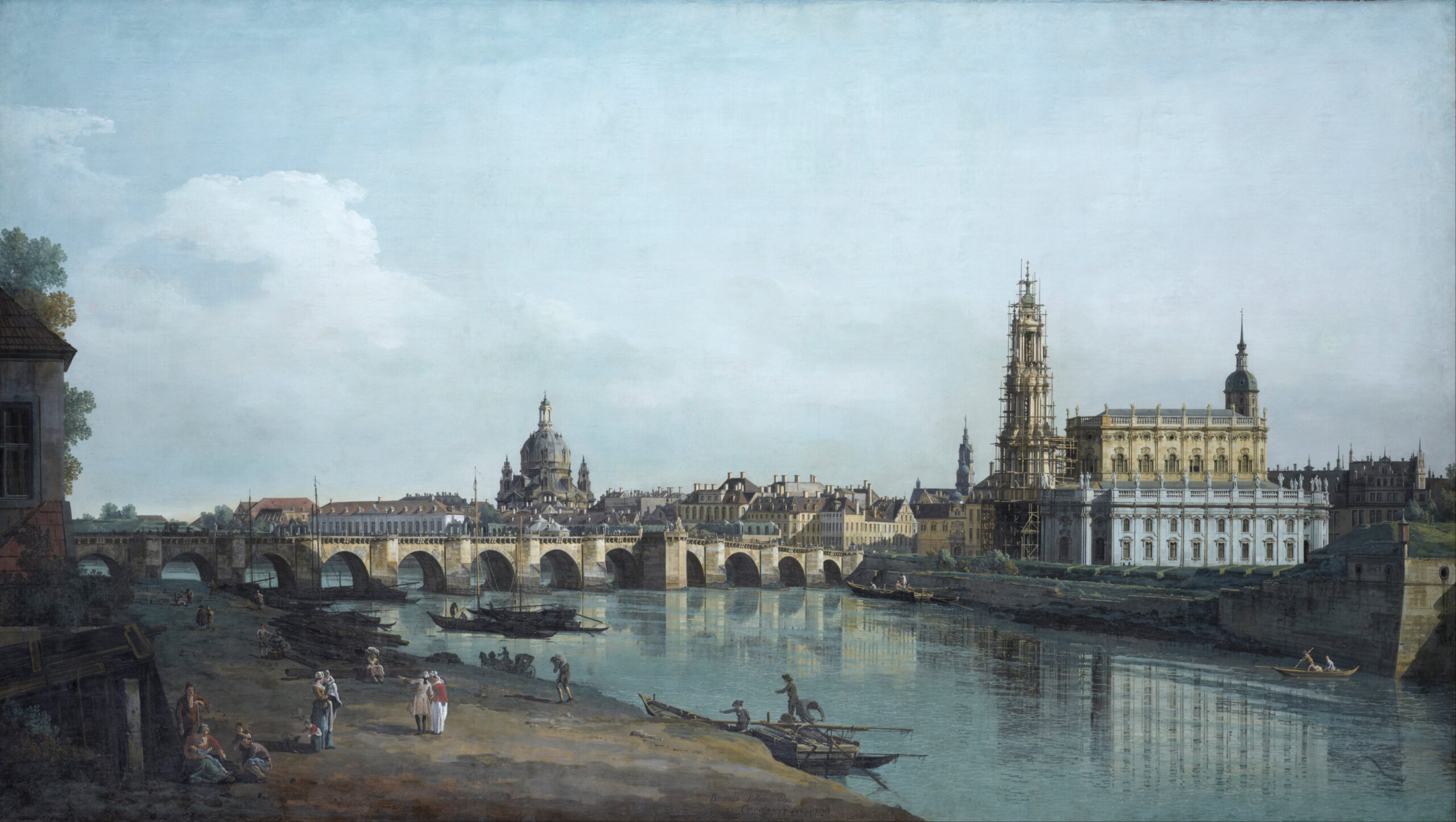
While Bach finalized the Mass in B minor in 1749, the work was assembled from components dating from different points in his career. The first two sections, Kyrie and Gloria, collectively entitled “Missa”, were composed in 1733 and presented to the new Elector of Saxony, Friedrich Augustus II (later August III of Poland), in Dresden, a Catholic court with a long and rich musical tradition. Many of the compositional choices that Bach made in these two sections of the work are aligned with the Dresden traditional practices and tastes.
Arguably, the Dresden esthetic continued to influence Bach as he decided to complete the 1733 Missa into a full Mass. The Credo, which Bach called Symbolum Nicenum, as well as the Ossana, Benedictus, and Agnus Dei were all composed in 1748-49. For the Sanctus, he resorted to a setting of the text that he had composed for Christmas 1724, with some adaptations. Based on the analysis of the manuscript scores, some scholars believe that the “Et incarnatus” section of the Credo could be the last vocal piece that Bach composed in his life.
The Mass in B minor is the culmination of Bach’s sacred vocal writing, an aspect of his industry that always carried a deep and very special significance to him. The work has earned a seat of honor among his late “summation” projects, such as the Art of Fugue, the Musical Offering and the Goldberg Variations, but unlike these, it can be heard as a retrospective synthesis of the vocal music traditions he inherited, mastered and transformed, bringing them together into a remarkably unified whole.